2025 State Assessments: Urban Charter Schools Continue to Close Gaps, Outperforming the State & Pre-Pandemic Reading Level – Charter School Students Are 50% More Likely to Read At Grade Level

Last week, the New Jersey Department of Education released the spring 2025 New Jersey Student Learning Assessment (NJSLA) scores for all public school districts in the Garden State. A vast majority of New Jersey’s 64,000 charter school students are students of color, and 76% of charter school students come from economically disadvantaged backgrounds. Charter schools are quickly closing the literacy gap and are within striking distance of outperforming the statewide average in one of the highest-performing public school systems in the country. Overall, 51.9% of charter students are proficient or higher in reading compared to the state average of 53.1%. In Newark and Jersey City, charter students outperform the state average in reading, while in Plainfield and Paterson, charter students have exceeded pre-pandemic reading levels.
“New Jersey’s public charter school assessment data is a true national success story,” said Harry Lee, President and CEO of the New Jersey Public Charter Schools Association (NJPCSA). “Charter schools serve many of the state’s most economically disadvantaged communities, yet charter students are performing on par with students in more affluent suburban districts. When schools are committed, focused, and meet students where they are, every child, regardless of zip code, can achieve at the highest levels. Public charter schools are a shining example of what happens when we invest in our children.”
Overall, public charter school students are making tremendous gains and are 50% more likely to read at grade level and 47% more likely to be at grade level in math compared to their district peers, as demonstrated by students scoring proficient (levels 4 or 5) in English language arts (ELA) and mathematics on NJSLA.
“Focused and caring educators, longer school days, more professional development, and a strong and positive school culture are the reasons why charter schools continue to succeed,” said TJ Best, Senior Advisor at NJPCSA. “With 64,000 students currently enrolled and 32,000 more students on wait lists today, charter schools are providing educational opportunities for families that change lives. We must support all of our public school students, including charter school students, by providing the proper resources they need to reach their fullest potential.”
An analysis of test scores disaggregated by the six cities that serve the largest number of charter school students demonstrates similar findings. Despite these schools serving more economically disadvantaged students than their resident districts, students at charter schools in Newark, Camden, Paterson, Trenton, Jersey City, and Plainfield are, on average, 71% more likely to read at grade level and 65% more likely to do math at grade level compared to their district peers. In the aggregate, urban charter schools in Newark and Jersey City continue to outpace the state average when it comes to students reading on grade level.
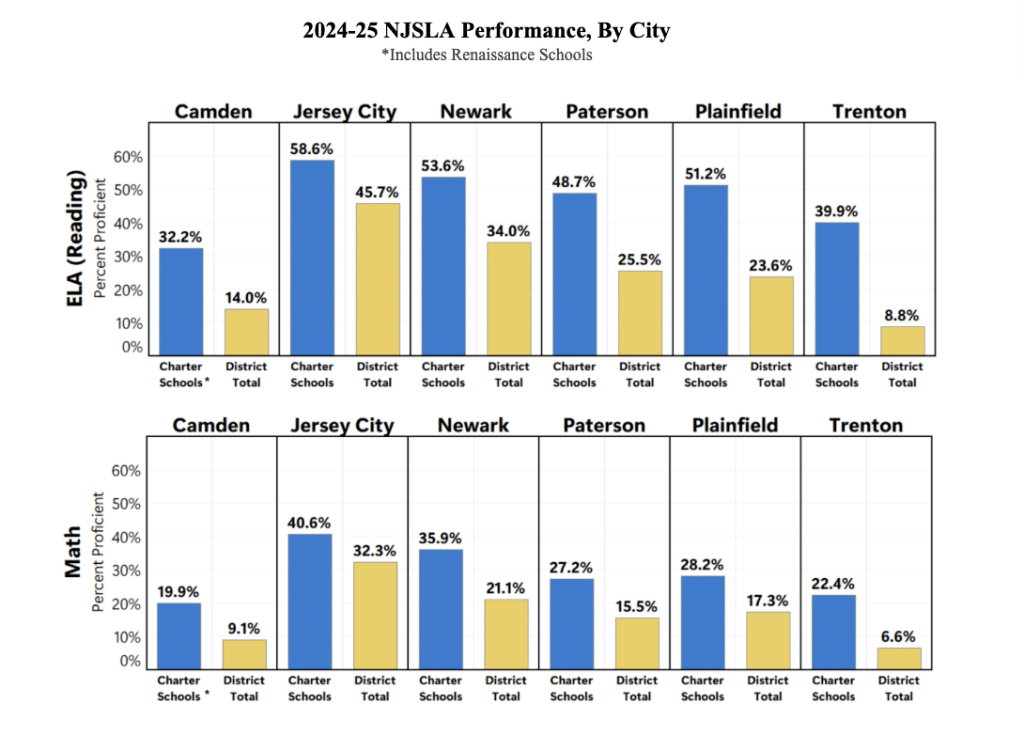
Trenton Charter Students Are 4.5x More Likely to Read at Grade Level
In Trenton, 85% of the city’s 4,200 charter students are economically disadvantaged, 10% are students with disabilities, and 9% are multilingual learners. A 2025 analysis shows that Trenton charter students are four and a half times more likely to read at grade level than their district peers. Despite serving just 20% of Trenton public school students, Trenton charters account for nearly 60% of all students reading on grade level in the city.
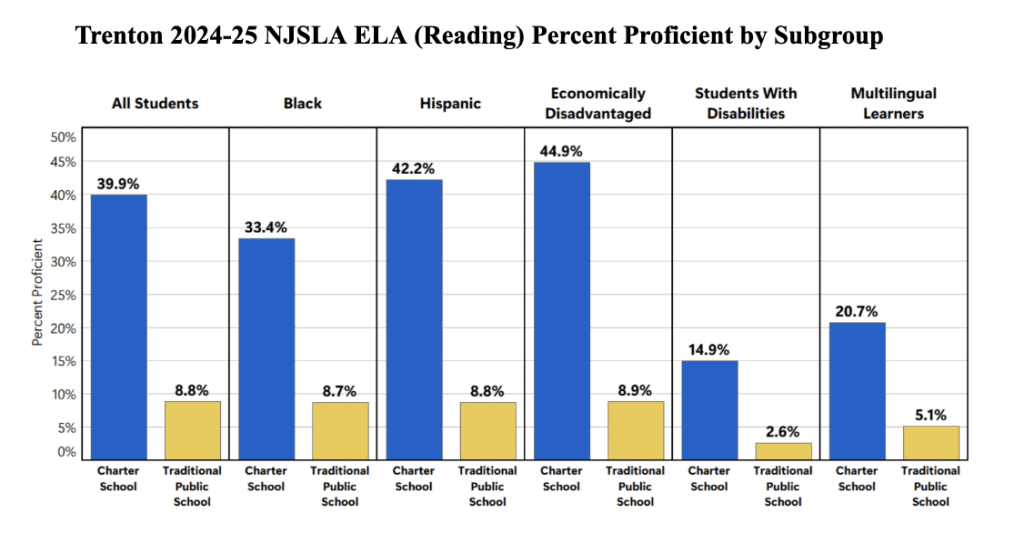
Foundation Academy Charter School in Trenton is closing the gap and is performing above pre-pandemic proficiency levels in reading. Reading proficiency has jumped by 22 percentage points since 2022 and is nearing the state average for all students.
“As a lifelong educator who grew up right here in Trenton, I’m incredibly proud of the work our school is doing to advance educational outcomes for our scholars,” said Sheria McRae, CEO of Foundation Academies in Trenton. “Our progress is driven by the combination of high-impact tutoring, a rigorous curriculum, and, most importantly, caring and dedicated teachers who believe in every child’s ability to achieve. We must continue to support all public schools, including public charter schools, that are helping scholars excel academically while preparing them for lifelong success.”