‘Skip the Stuff’ law: How the plastic utensil ban will impact restaurants and the climate
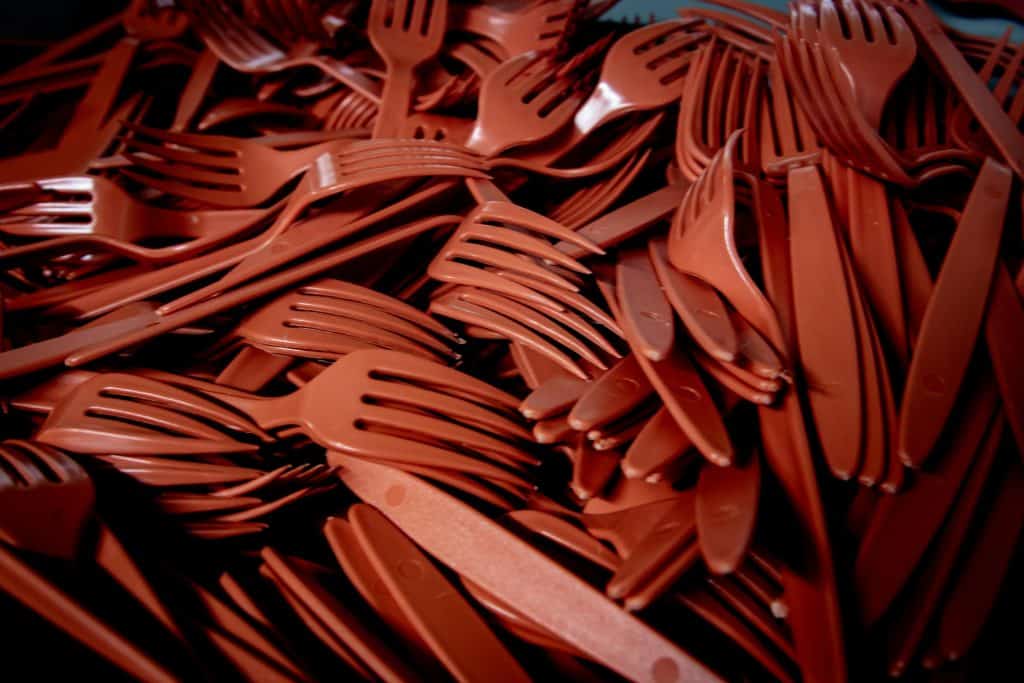
Restaurants will stop offering customers plastic utensils in August under the state’s controversial new “Skip the Stuff” law.
The law is aimed at reducing plastic waste and lowering the impact of plastic usage on the environment. It prohibits food service businesses, such as restaurants, cafes, and food trucks, from giving customers single-use plastic utensils and condiments, unless requested specifically by the customer. Failure to abide by the law would prompt a warning for a first offense and a $100 fine for a second offense.
The law also requires the New Jersey Department of Environmental Protection to establish campaigns to educate New Jerseyans on the benefits of prohibiting single-use utensils.
Former Gov. Phil Murphy signed the law on his last day in office, in an effort to limit the effects of climate change in New Jersey.
The “Skip the Stuff” law is one of several in recent years aimed at plastic waste, which has put New Jersey at the forefront of such efforts.
“New Jersey, being the most densely populated state in the nation, certainly has the ability to make a big impact on reducing plastic pollution,” said Jennifer Coffey, the executive director at the Association of New Jersey Environmental Commissions. “The United Nations has recognized New Jersey’s law as the most effective in the entire country.”
But Garden State restaurant owners and an industry group are skeptical that the “Skip the Stuff” law will have a meaningful impact.
Bradley Cook owns a handful of restaurants across South Jersey, including Carolina Blue, The Telford Inn, and The Shipyard. For his restaurants, guests are given the option to include plastic cutlery for to-go orders on their checks.
“Fortunately, it doesn’t affect our business much,” said Cook. “Frankly, the entire ban is a bit of a head-scratcher. All restaurants run on notoriously tight margins, and giving away unneeded utensils simply doesn’t make financial sense so why take the time to regulate it?”
But New Jersey isn’t alone in the effort. States, including California, are trying to limit their plastic use, Coffey said. As of 2025, there are no federal plastic mandates.
With their low price and accessibility, plastic cutlery is a staple in many food service businesses across the globe. The plastic tableware may be an easy way for customers to dine and dispose, but these utensils have a long-lasting effect on the environment.
The production of plastic products significantly affects greenhouse gas emissions, yet they are often disposed of after one use. The greenhouse gas emissions may be a large environmental concern due to plastic production, but it isn’t the only climate concern.
Research shows that once plastic products are disposed of, they can take anywhere between 100 to 1,000 years to decompose, according to the United States Environmental Protection Agency.
“They’re pretty durable, and they are inexpensive to produce, so they’re characteristics that we humans value,” said Elizabeth Ravit, the co-founder of the Rutgers Center for Urban Environmental Sustainability. “But their durability and strength that comes from their chemical structure means that often, when they are released into the environment…they don’t break down the way many materials do in the environment, so they can build up.”
As plastics pile up, they collect in landfills and waterways, not only putting wildlife at risk but also having an effect on air pollution.
The production and use of plastics may be harming the environment, but New Jersey lawmakers have been taking action in hopes of reducing the effects. Before the “Skip the Stuff” bill was signed into law, the Garden State had a law prohibiting the sale of plastic grocery bags.
In May 2022, Murphy signed a bill into law that limited providing customers with single-use plastic bags from retail stores, grocery stores and food vendors.
Since the law has been in effect, New Jersey shoppers have switched to using their own reusable bags or purchasing them at stores if they forgot their own.
It’s been over three years since the grocery bag ban started, and many claim to see the effects. According to the New Jersey Clean Communities, the ban has removed 24 billion single-use plastic shopping bags and 480 million paper bags from the Garden State.
Ravit also thinks the plastic bag ban was a big success.
“That ban, in my opinion, was very effective because it was… very easy to understand, and it was very easy for state regulators to monitor,” said Ravit.
Ravit may be optimistic about the effects of the grocery bag ban, but she has her concerns about the single-use plastic utensil ban after seeing the results of the plastic straw ban set in 2021.
“In my opinion, the straw ban was not an effective law. It was very hard to monitor. It was ambiguous, because restaurants weren’t supposed to give us straws,” said Ravit. “They had to keep them on hand in case people wanted them, and then people could ask for them. So it was very hard to see if people were complying or not.”
Ravit is worried the single-use utensil ban will see the same results.
“This is my personal opinion, but when you say you can’t hand out plastic utensils unless they’re asked for, it’s the same type of ban as the straw ban, and I have grave concerns that it really isn’t going to be as effective as the plastic bag ban,” said Ravit.
Ravit isn’t the only one with concerns. Senator Declan O’Scanlon Jr., a Little Silver Republican, worries about the impact on businesses.
“We’re talking about food operations where things get crazy, and these people are used to hiring young people that don’t go through extensive training. They’re taking different calls, they’re packing different orders, and things move quickly,” O’Scanlon told New Jersey 101.5. “It doesn’t take more than a couple of accidental oversights, and it’s huge money for them.”
While O’Scanlon argues that this ban will have an economic impact on restaurants, others understand the concern but are remaining optimistic.
“I would say that I certainly understand the economic struggles of individuals and businesses, particularly in this climate. And the tariffs have certainly made everything more expensive, and we are still coming out of a period of some pretty severe inflation,” Coffey said. “This law will actually save restaurants money, because they don’t have to give every takeout order plastic utensils…So we’re hoping that this helps the restaurants and that it helps with reducing bulk waste and plastic pollution as well.”
Coffey may be optimistic about the ban, but others are confused by it.
South Jersey restaurant owner Cook understands the environmental benefits that come with the law, but doesn’t understand why government agencies aren’t held to the same standards.
“I also find it a bit hypocritical that schools and jails are exempt from the ban. I guess plastic used by government institutions isn’t as bad for the environment,” said Cook.
Cook isn’t the only one with doubts. Daniel Klim is the president and CEO of the New Jersey Restaurant and Hospitality Association, and he is concerned about how the law will actually play out in busy restaurants.
“Restaurants operate in fast-paced, high-volume environments,” Klim told Fox News Digital. “Policies that don’t fully reflect those realities can create operational challenges and added costs, particularly for small, independently-owned businesses.”
Nonetheless, Klim is hopeful that the collaboration with the bill’s sponsors will help find a middle ground.
“We appreciate the sponsor’s willingness to work with us,” Klim added. “We believe collaboration is essential to reducing waste without placing unnecessary burdens on small businesses or their customers.”
This article is written by Katie Thorn, courtesy of the NJ State House News Service