Foundation Academies students bring the Revolutionary War lives of forgotten Black patriots to life
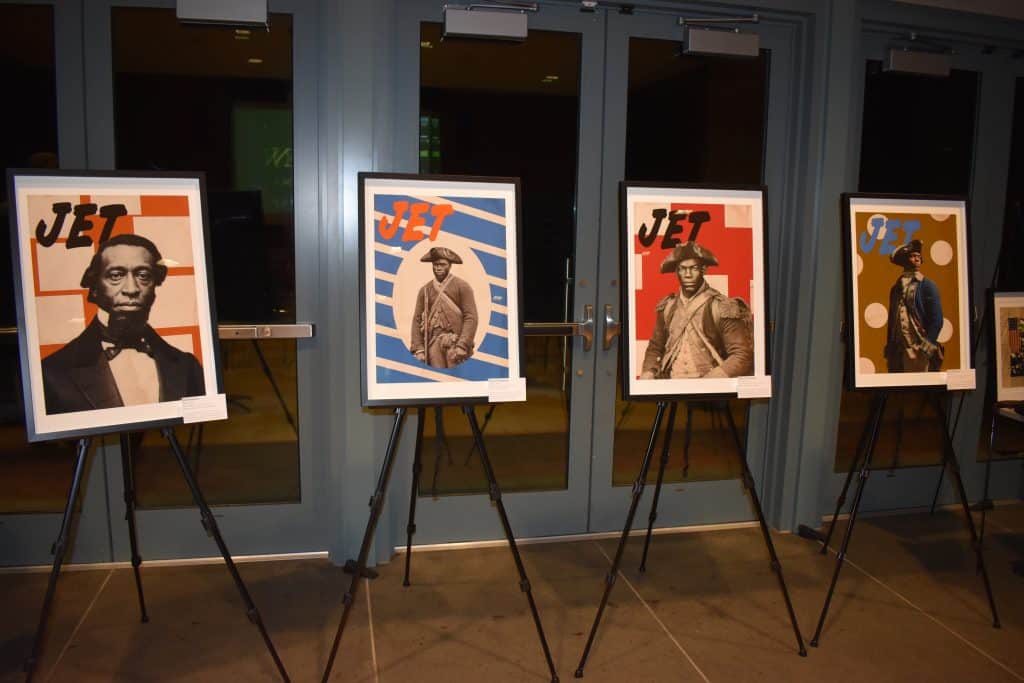
Student scholars from Trenton’s Foundation Academies created an exhibition that celebrates the 14 Black Revolutionary War soldiers who fought in the Battles of Trenton and Princeton. Photo credit: Katherine Burgos / NJ State House News Service
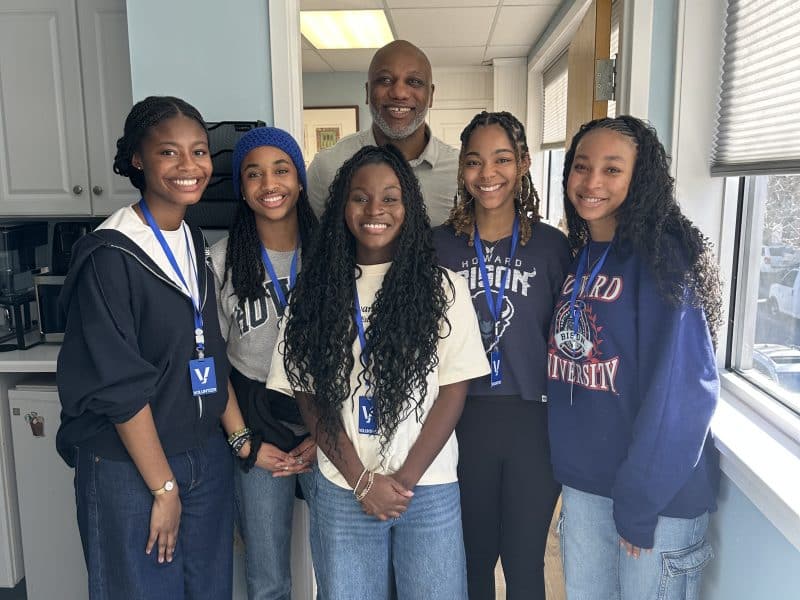
There is no American history without Black history,” said Casey Scott, one of the advisers of the Black Student Union at the Foundation Academies, at the opening night of a Revolutionary War exhibit that a team of Trenton high school scholars took over a year to create.
The Black Student Union at Foundation Academies dedicated research and time toward Black soldiers who fought in the American Revolutionary War, with a project named “Men Without Shoes.”
Mark Herr, a trustee from the Princeton Battlefield Society, explained where the name of this project came from: “Look at most of the paintings of the Revolution and they usually feature generals and other officers … The officers always wear gleaming boots and wave shiny swords. The enlisted men – not so much. In fact, when the army marched to Princeton in the wee hours of January 3, diarists noted they could track the army by the blood in the snow from the men without shoes.”
The exhibit is a tribute to 14 men they call “forgotten heroes,” named Charles Ailstock, James Ailstock, Job Lathrop, Edward Ned Bradley, Phillip James, Primus Hall, Robert Prince Green, Edward Hopps, Cato Smith, Isaac Walker, Peter Jennings, Jacob Francis, Oliver Cromwell, and Samuel Sutphin.
“Men Without Shoes” was created with help from the Princeton Battlefield Society, as trustees from the Society approached the Foundation Academies for help on this research project. Herr found himself pondering the role of Black soldiers and their role in the American Revolutionary War.
“Tonight we’re going to solve a history mystery: who were the ordinary men who did something extraordinary 250 years ago: win our independence…That led to an inquiry posed to a very gifted [Daughters of the American Revolution] researcher, Pat Romagna. She put together a list that captures about a quarter of the American troops. And she noted that on that list, at least 14 were Black soldiers,” said Herr.
And from there, the Men Without Shoes project, in collaboration with the Black Student Union at Foundation Academies, was born.
For the past year, scholars from the Black Student Union have dedicated countless hours to researching online, at the New Jersey state archives, and even used generative AI to create portraits of the Black soldiers who fought in the American Revolutionary War.
The exhibit features portraits of each of the soldiers, one of whom has living relatives who were unable to attend the exhibit.
Earl Wallace, another adviser from the Black Student Union at Foundation Academies, explained: “It was a real long process … I enjoyed it because I got to work with the students … and they made the process easy.”
One of the scholars, Amyah Spears, also commented on her process working with the BSU on the Men Without Shoes project. “It was definitely very challenging, but I definitely appreciated it as it helps me grow … This entire experience has helped me grow and also helped me learn more about my culture.”
Another scholar, Melchizedek Worrell, commented on the use of generative AI used in making this project come to life. “AI is not necessarily seen as good, but the fact that we can turn something that is viewed as negative into something that is viewed as positive is truly amazing. It shows that AI is just the future; we contribute to that future also, and we can use different tools for different things to contribute to that future.”
In their video presentation, the young scholars used generative AI to create not only images of what the 14 Black soldiers might have looked like, but also created a video that brought their experiences to life. The video examined the soldiers’ roles in the war, as well as their lives afterward in the new nation. Together with the Princeton Battlefield Society, the Foundation Academies students worked to bring a hidden part of New Jersey history to light during the nation’s 250th anniversary, being celebrated this year.
As part of Black History Month, the free, multimedia exhibit “Men Without Shoes” will be open to the public on Saturday, Feb. 21, 2026, from 10 a.m. to 4 p.m. at Morven Museum, 55 Stockton St. in Princeton.
This article is written by Katherine Burgos, courtesy of the NJ State House News Service