Outdoor Equity Alliance expands environmental efforts with grants and new headquarters

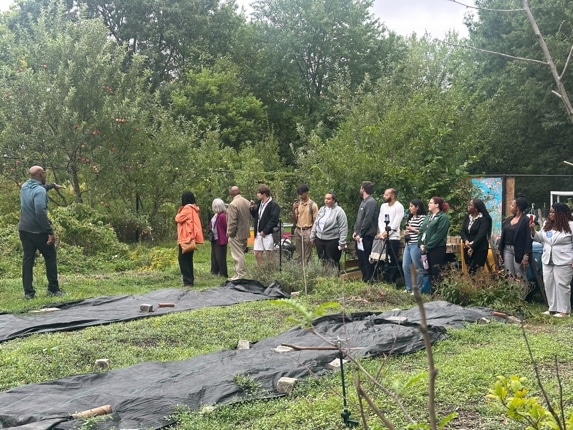
State Street will be noticeably greener in the spring thanks to Trenton’s community tree planting day earlier this fall. These young native trees begin a collaborative effort to plant 1,000 trees in the city in a few years. Several organizations are participating in this initiative, and among them is the Outdoor Equity Alliance and its tree ambassadors. The OEA’s program coordinator, Elizabeth Reyes, was struck by the effect that planting and naming trees had on the teenagers she worked with near George Page Park that day.
“Now I get to hear from those students all the time [who say], ‘Oh, I passed by my tree the other day.’ They developed a great connection with the trees that they planted,” Reyes says. “The fact that it’s something that they did with their own hands and they can go back and say this is one thing that I did for my community is a great feeling for us as program coordinators and people who are working behind the scenes.”
Fostering this connection with local nature and community is a major part of the Outdoor Equity Alliance’s goals for the city of Trenton and beyond. Founded under the Friends of Hopewell Valley Open Space over a decade ago, the OEA achieved 501(c)(3) status last year and is moving forward with making their mark as an independent nonprofit.
As part of this re-brand, OEA Executive Director William Wilson is working to define the mission of the organization going forward. “Our new mission is to create equitable access to nature in all communities and inspire a diverse new generation of environmental leaders,” Wilson says, adding, “that’s an incredibly important and exciting concept to strive and move forward especially talking about a community like Trenton.”
He breaks the overarching mission into three key actionable objectives that he hopes will allow people to find where they fit in the organization’s mission. Wilson defines them as, “diversifying the next generation of environmental leaders…transforming our communities through conservation, and driving urban forestry in cities.”
In October, the Outdoor Equity Alliance acquired a brick-and-mortar office at 407 West State Street, which both Reyes and Wilson believe has already had a positive impact on the organization’s programming and its ability to synthesize with the community needs. Staff and community members alike can even see the trees they planted outside their windows.
Reyes says, “We have a conference room, and we also have a classroom that we can utilize, and that also gave us a lot of hope, and kind of a push to really get our mission out there and make the differences that we want to see in the city of Trenton.”
The new space also gives the organization influence on the physical area where they are located, as they have recently been awarded a $12,000 grant to revitalize the bridge across the street to better connect Trenton’s greenways. Residents have also begun emailing the OEA about anything they notice or are concerned about with the local trees, which Wilson finds heartening. “I love that when people think about something environmentally related in the city of Trenton, they’re calling us,” Wilson says.
Another recent grant the organization has been awarded is $6,000 through the Community Forest Corps for a program that will cover three years of urban canopy work and maintenance. The OEA will be able to hire a full-time urban forestry equity fellow which furthers their goals of bringing conservation jobs to the city of Trenton. In addition to this, the OEA is launching a fellowship with Mercer County Community College.
“We’re going to create a program for students who are looking to go into plant science or anything environmentally related. We are going to let them apply for a fellowship that’ll pay for their school. It [will] give them health benefits, it [will also] give them a job so they don’t have to worry about working while in school, and then it will all end with [them] doing an environmental stewardship project in Trenton,” Wilson says.
The OEA has many more projects in the works for 2025, including a re-brand of their urban agriculture program in partnership with Capital City Farms as “City Roots,” and a hope to work with even more local organizations. William Wilson’s hope for the future is that the OEA and its partners can set a standard of cooperation and community engagement towards urban forestry and conservation that will spread.
Wilson says, “There are so many organizations that could come together to say, ‘There is an opportunity here in the community to have this great thing be maintained by the great people in our community,’ and then have that move forward. I think that model of the connection between philanthropy, nonprofits, and community can be a beacon in Trenton that we can then replicate in Newark, Camden, and Philadelphia.” For more information on the Outdoor Equity Alliance and how to get involved, visit their site at https://outdoorequityalliance.org