The Education and Employment Program at the Trenton Area Soup Kitchen goes above and beyond for its patrons

Trenton Area Soup Kitchen (TASK) served its first meal in 1982, in the basement of what is now known as Turning Point United Methodist Church. The past 43 years have marked decades of significant change and growth. Today, TASK is more than a soup kitchen, as it aims to encourage self-sufficiency and improve the lives of its patrons through various programs and services.
The Adult Education Program was established in 1992 with an initial focus on literacy, primarily working with middle-aged adults at a low literacy level. Over time, it has evolved into a multi-resource program, according to Calmia Hart, director of the Education & Employment Program.
Hart explained that before 2014, those who did not graduate from high school had two options: attend a night school program or take a standardized exam called the General Educational Development (GED) test. This same year, the Department of Education introduced two additional tests to acquire a high school equivalency diploma, known as the TASC and the HiSET.
These tests provided flexibility for TASK, as both computer-based and pencil-and-paper style exams were tailored to the diverse needs of its patrons, as many lack digital literacy skills.
However, the department discontinued the TASC in 2021 and the HiSET in 2023 in New Jersey, and increased the difficulty of the GED exam, in an effort to align the test with common core standards.
There has been no annual data published by the National Center for Education Statistics on the percentage of GED earners since 2013. However, the Hechinger Report found evidence of a 40% decline in the number of people passing high school equivalency exams in nearly every state, from 2012 to 2016. TASK has seen this trend persist even after the removal of the two additional exams.
“The rigor of the test increased, and with that, there’s been a downshift for the last ten years, not just in Trenton, not just in Mercer County, and not just in the state of New Jersey,” Hart said. “It’s on a national level. A downshift in the number of individuals who are completing the full battery for this test, meaning fewer people are getting their GED.”
Hart explained that during the pandemic in 2020, TASK’s facilities were closed, and tests were conducted fully remote, creating a barrier for those who lack digital skills or access to technology, forced to put their dreams on hold until in-person activity resumed.

Erik Massey with two peers in the digital literacy class, along with Calmia Hart, Director of the Education to Employment Program and Digital Education and Resource Coordinator Carolyn Burke.
TASK’s full reopening saw increased interest in the computer lab for employment-related assistance. People were asking volunteers in this space for help with resumes and job applications. With this, TASK naturally decided to integrate the education and employment program in 2022.
“Adult education encompasses so much,” Hart said. “We are heavily focused on developing them to be strong job seekers and strong employees because once they get the job, is half the battle. It’s keeping the job.”
David Schweder studied in the tutoring program to receive his GED last year, has benefited from digital literacy training and job search support, and is now employed at TASK.
“When you don’t have a job for a while, you fall into a rut, and getting out of it is not always super easy,” Schweder said. “You go from not working an hour over the last six months to all of a sudden working forty hours a week, and it drains on you, or it doesn’t work out particularly perfectly, and that creates a negative experience, and you dread going to work. With TASK… they were always extremely willing to work with me and never at any point made me feel overloaded.”
According to Hart, many employers are not as adamant about having a high school diploma as they once were for certain entry-level positions, which is why TASK also exposes patrons to alternate routes like a 10-week culinary program and Security Officer Registration Act (SORA) license training for security officer positions.
While TASK provides exceptional support for those looking to upskill their careers and transform their futures, certain challenges discourage prospects from taking the first step of walking through the door. Among the biggest are mental health issues, substance abuse challenges, and histories of incarceration, according to Hart.
“Trusting people is a big thing for many of the people that we work with,” Hart said. “A lot of them have shared they were told they were dumb. Growing up, there may have been some learning barriers for them. You never know.”
Fortunately, TASK’s case management department helps patrons navigate initial discomfort by supporting and educating them about its resources until they are comfortable enough to open up and inquire about additional services.
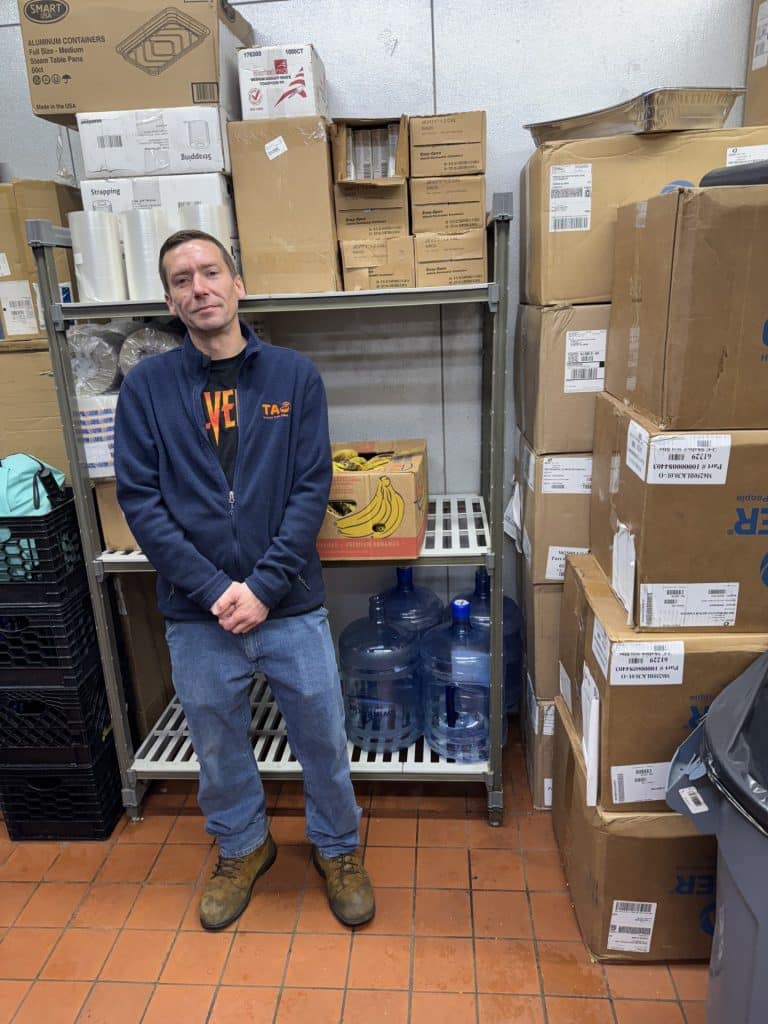
“I wanted to get my GED because while I was in my early 40s, and it never held me back from getting a job because I always lied but…it’s always that thing that sort of hangs over you that you’re never really proud of, and you know, I just got sick of lying,” Schweder said.
Hart explained that the Education & Employment Program provides one-on-one individualized attention, as opposed to a group or classroom setting where one individual is teaching multiple people at different levels. Volunteer tutors make this approach possible.
“I passed everything on my first time and I owe that to them and they always say, like it was in you, you did it, you did the work and yeah, I agree with that to a certain extent, but it was in me for forty years and I never did anything with it until I showed up here and within a matter of a few months, I was able to achieve something,” Schweder said.
Carolyn Burke, the Digital Education and Resource Coordinator, monitors the computer laboratory, assisting with simple to complex requests. On Fridays, a group from the Bank of America corporation dedicates a volunteer to this space, allowing Burke to have a work-from-home day each week.
Schweder expressed gratitude for Ms. Burke, who helped him understand how to use Microsoft OneDrive, Google Drive, LinkedIn, and upload his resume to job search websites.
TASK offers on-site job search support, with their Workforce Development Coordinator and Employment Support Specialist providing free career counseling, career readiness and life skills training. They also host on-site hiring events with local businesses and create job opportunities aligned to their patrons’ abilities. Hart expressed that they spend a lot of time and effort cultivating relationships with employers who understand the population they serve and the mini barriers that many of them face.
Schweder started as a part-time dishwasher for TASK while studying for his GED and now works in logistics, including shipping, receiving, and other organizational tasks.
“I love my job,” Schweder said. “Like, I’m not kidding you. You can ask anybody…I don’t say ‘oh I gotta go to work. I get to go to work, and it’s because of the people here.”
Erik Massey, a participant in the digital literacy program, initially came to TASK for its meal service, and realized that they offer a computer class, which was up his alley, because he is interested in video game development. Massey has been going to TASK for over a year and is currently in the intermediate digital literacy class.
“I’m hoping I can get my GED and go to school,” Massey said. “I want to get into video game making and computer graphics and all that, and the computer class seemed like a start to get more trained on computers.”
Massey expressed that the course taught him a range of digital skills, including creating presentations on PowerPoint, using Microsoft Word, making business projections using Excel, and learning how to use ChatGPT, which was a “game changer” for him.
“[TASK] helped a lot,” Massey said. “It changed how I carry myself. “The teacher is very good…she goes above and beyond what she’s supposed to do, I think.”
According to Hart, it is an everyday challenge to connect the community to resources due to TASK’s limited capacity. In the Education & Employment Program, there are only five staff members, including herself.
Streetlight reported that TASK receives only 3% of its funding from federal, county and state resources. The organization is heavily supported by monetary contributions, in-kind donations like laptops, and volunteers.
The laptops are a huge need because those who complete the digital literacy program are gifted a refurbished laptop.
Volunteer tutors must be adults, but are not required to have any teaching experience. They look for those with compassion, empathy, and a basic understanding that the people in the program may be in vulnerable positions.
“For the volume that we serve, it’s just amazing that we’re able to do what we do,” Hart said. “What it takes to accomplish it, people may not realize what a huge undertaking it is and what it takes, not only to sustain, but to grow.”