Work with ICE or fight it? States face immigration divide
Immigration and Customs Enforcement, whose actions have been the subject of nationwide protests and contentious debate, is the target of legislation proposed in New Jersey and states across the country.
Bills in some states would prohibit ICE officers from wearing face coverings, operating near schools and churches, and using surveillance technology for immigration enforcement. Other states would require cooperation between state and local law enforcement and federal immigration authorities.
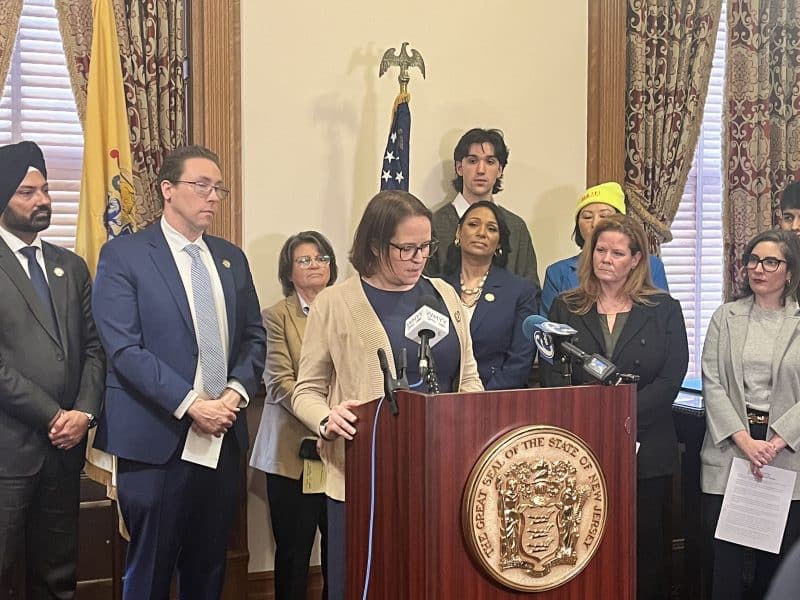
In New Jersey, where Democrats control the legislature and governor’s office, lawmakers are revisiting legislation aimed at strengthening privacy and transparency, including a proposal that would bar law enforcement from concealing their identities.
Senate Bill 3112 would prohibit on-duty officers from wearing face masks or disguises in the Garden State. A similar bill was introduced last year, but didn’t progress.
Garden State lawmakers have also introduced several additional privacy bills in the new session. Bill SR130 demands the reversal of the federal policy in which the IRS shares private taxpayer information with ICE.
“Transparency and public trust are essential to effective law enforcement,” Republican Sen. Jon Bramnick of Westfield said.
After ICE has raided several cities across the country to detain immigrants who do not have proper documentation, the topic of immigration enforcement and how it should be carried out has become a nationwide debate.
After a crackdown in Minneapolis, when an ICE officer shot and killed Renée Good and federal immigration agents shot and killed Alex Pretti, the agency has received a range of responses, including anti-ICE protests and support for ICE in many state legislatures.
As of Feb. 7, more than 68,000 people are in immigration detention, with the most being in Texas at more than 18,700. New Jersey’s two detention centers held 985 individuals, according to the Transactional Records Access Clearinghouse, a database run by Syracuse University.
In at least 21 states, lawmakers have proposed regulations for how state and local law enforcement officials must interact with ICE — some requiring cooperation with the federal agency and some prohibiting it.
Lawmakers who want to rein in ICE operations have proposed legislation prohibiting state and local law enforcement from cooperating with the federal agency.
Those who have proposed pro-ICE bills want to allow so-called 287(g) agreements, a program that allows state and local law enforcement to enforce immigration laws, too.
Several bills in favor of cooperating with ICE reference the Laken Riley Act, which requires the Department of Homeland Security to detain non-U.S. nationals who have been arrested for crimes like theft and larceny. State bills referencing the legislation would extend the same requirements to the state, mandating immigration detainers for specific offenses, including federal crimes or crimes of violence.
Cooperation between state and federal law enforcement
A major point of discussion in legislatures is the extent to which state and local law enforcement ought to cooperate with ICE. Many states and municipalities are voting on whether they will enter 287(g) cooperation agreements with immigration agents.
New Jersey already has an Immigrant Trust Directive, which restricts state law enforcement from cooperating with ICE, implemented by former Gov. Phil Murphy.
In Maryland, a law banning local law enforcement cooperation with immigration officials has passed, requiring the termination of any immigration partnership agreements by July 1. Bills against cooperation with federal immigration enforcement have been proposed in states including Minnesota, Kansas, Arizona, New Mexico, and Virginia.
Debu Gandhi, senior director of immigration policy at the Center for American Progress, believes public safety is a priority when considering how ICE and local law enforcement ought to interact.
One of his concerns with agreements between the two is that they’re a drain on time and money.
“It takes away resources from their day jobs of policing and protecting public safety,” he said, when the goal should be “community-oriented policing.”
Gandhi hopes to see transparency, accountability, and “reasonable use-of-force guidelines” as well as federal officers being unmasked and carrying identification.
“You expect that of our local police. Is it too much to expect out of federal law enforcement? I don’t think so,” Gandhi said.
In the Arizona legislature, where Republicans control both chambers, Democrats have tried unsuccessfully to cut off cooperation.
On her first day in office, Virginia Gov. Abigail Spanberger rescinded her predecessor’s executive order that allowed cooperative agreements with ICE. In mid-February, she instructed state agencies to note any such agreements, terminate them, and identify when they end.
Favoring Cooperation
Legislation in favor of working with ICE includes protections for officers, requirements for cooperation, and allowances for local officers to serve immigration warrants.
Minnesota Republicans say they intend to revive a bill requiring local governments to cooperate with federal immigration enforcement. Additionally, two bills were introduced that would protect the personal information of public safety officers and make protesting at people’s homes a crime.
In Arizona, six out of 15 counties already have partnership agreements with ICE. In the Republican-controlled legislature, pro-cooperation measures are advancing.
“Arizona will no longer be a safe harbor for illegal activity or a place where federal laws are ignored,” Republican Sen. Wendy Rogers, who authored the bill, said in a news release. “These bills are about accountability, lawfulness, and protecting Arizonans.”
One national organization, the Federation for American Immigration Reform, aims to “reduce overall immigration to a more normal level” to maintain a high quality of life, its website reads.
Ira Mehlman, FAIR media director, said part of what the organization wants is not just reduced immigration, but public safety, management of resources, and accountability for those who commit crimes.
“The laws exist to protect the interests of the American public,” he said, and that sanctuary cities can attract people who come illegally because they know they will be protected.
“When you have people who move into your community, you are obligated to educate their children. People turn up in emergency rooms. All of these things drain on resources,” Mehlman said. “Quite frankly, those are the reasons why we have immigration laws in the first place.”
Face coverings for law enforcement
Many ICE agents have been seen with much of their faces covered, sometimes wearing hats, sunglasses, and gators that cover the mouth and nose. Several bills nationwide are looking at agents’ workwear while trying to balance officers’ anonymity and ability to identify them, including the measures pending in New Jersey.
In Minnesota, two bills would ensure ICE agents are easily identifiable, keeping them from being what sponsor Democratic Rep. Leigh Finke described as the “secret police.”
One bill would ban masks and require agents to have visible identification. Another would require vehicles that transport detainees to be marked as law enforcement and restrict the use of civilian vehicles in ICE activities.
“No more secret police, no more broken families, no more illegal detentions and no more killing of our citizens,” Finke said at a recent news conference. “Let’s stand together as a DFL (Democratic-Farmer-Labor Party) and a Minnesota GOP and say no more.”
This time, legislators from both parties have voiced support for the bill. On Feb. 12, an identical Assembly measure advanced out of committee on a 5-2 vote.
In Virginia, a measure would ban most law enforcement officers from wearing face coverings that hide their identity on duty, with some exceptions. It passed the Senate and is now under review in the House.
Privacy and location restrictions
Many states have seen bills proposing restrictions on where ICE can operate.
One of New Jersey Gov. Mikie Sherrill’s first actions was signing an executive order preventing ICE agents from staging operations on state property. The federal Department of Justice has filed a lawsuit challenging her order.
Lawmakers in Kansas, Georgia, Missouri, and Virginia proposed measures to limit ICE searches and raids, protect student data, limit access to surveillance technology, or shield immigration status found in medical records.
George Escobar, executive director of We Are CASA, a national advocacy group for marginalized communities, said it’s important that state resources are not used inappropriately when working with the federal government.
“Right now, ICE is a rogue, federal paramilitary organization that is going completely beyond the letter of the law in its tactics,” Escobar said.
This article was produced through the Statehouse Reporting Project, a collaborative effort by collegiate journalism programs across the country. The lead reporter was Zoe Naylor of the University of Missouri, and contributors were Sarah Shockey of Rowan University, Elliot Akerstrom of the University of Kansas, Natalie Ogami of Arizona State University, Victor Martinez of the University of New Mexico, Aleks Arwood of the University of Georgia, Grey Steele of the University of Tennessee at Chattanooga, Hannah McDonough of the University of Missouri, Abbey Mulcahy of the University of Minnesota and Alessandra Caceres Mendoza of Virginia Commonwealth University.