Sherrill blocks grocery surveillance pricing, vows to protect personal data of noncitizens mistakenly registered to vote
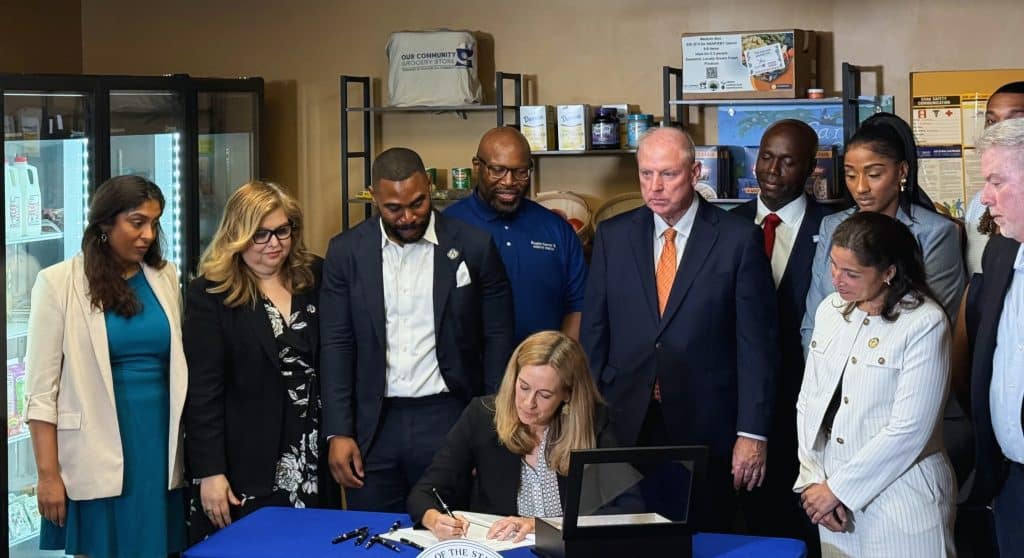
Standing between refrigerators of eggs and lettuce in the tiny Our Community Grocery Store, Gov. Mikie Sherrill signed a measure Thursday blocking surveillance pricing.
Amid a flurry of questions from reporters, Sherrill also pledged that her administration would not provide federal authorities with the personal data of noncitizens the state mistakenly registered to vote.
The Department of Justice has demanded the names, addresses, and nationalities of about 6,600 noncitizens that Sherrill announced Tuesday had been registered to vote in error by the state Motor Vehicle Commission.
“We are not in the practice of turning this kind of personally identifying data over to the federal government,” Sherrill said, adding that the state is independently investigating the errors that occurred between June 2023 and June 2024 and is terminating the contract with the software provider.
“It is not a surprise to me that the federal government, the Trump Administration, wants to immediately weaponize this against people as opposed to focusing on making sure that we’re running free and fair elections. That’s my focus,” Sherrill said. “I will say again that Trump has done more to undermine the election system than anyone in my lifetime, including Vladimir Putin.”
Sherrill said about 400 ineligible people cast ballots.
Her focus of the day, however, stood in signing the Fair Price Protection Act. Sherrill said retailers should not be allowed to raise prices based on shopping history or where they live. “That’s just wrong. People deserve privacy. They deserve fair prices.”
The measure passed by the legislature last month prevents stores from setting prices based on personal data. It faced fierce opposition by Republicans in both the Assembly and Senate, who argued it could limit personalized coupons or shoppers’ loyalty rewards.
But Sherrill said the measure will not affect any loyalty or rewards programs in place. Instead, she said it will monitor pricing to ensure that stores do not artificially increase their prices just to later provide a phony discount that lowers rates back to their actual value.
According to Sherrill, Consumer Reports investigated the issue and found that some shoppers were charged up to 20% more for certain items. “Over the course of a year, a family could spend $1,200 more for the very same groceries just because of an invisible algorithm,” she said.
Joining Sherrill at the podium were two of the bill’s primary sponsors: Democratic Sen. Joseph Cryan of Union and first-term Assembly Member Chigozie Onyema, a Democrat from Maplewood.
“It’s as American as apple pie that we all pay the same,” Cryan said.
Sherrill said the measure will also institute a one-year pause on the use of digital shelf labels, to allow experts to study the impact on prices and shoppers, ensuring a “more affordable and more accountable” New Jersey.
Onyema, whose district includes the Newark store where the signing was held, said that local families were directly feeling the negative outcomes of surveillance pricing.
“These companies know they know more about us than anyone, and they use that information to charge different prices to different consumers,” he said. “For much of the last decade, we’ve seen corporations try to squeeze more profit out of everyday transactions. Many of them are trying to build a world where the price of basic necessities no longer reflects supply and demand, but instead what an algorithm predicts it can extract from each consumer.”
“The question is no longer ‘what is this worth?’ it’s ‘how much can we extract from each of the individual persons?’” Onyema said.
Henal Patel, interim president and CEO of the New Jersey Institute for Social Justice, said that the bill heightens economic justice within the state, especially for low-income consumers who are disproportionately impacted by hikes in prices.
United Food and Commercial Workers Union International Vice President Ademola Oyefeso called the Fair Price Protection Act the “strongest bill around surveillance pricing in the nation,” crediting its effort to bar in-store attempts at price gouging with being the first of its kind in America.
This article was written by Gianna Puglisi, Courtesy of the NJ State House News Service.