A nuclear future: New Jersey passes bill to expand nuclear energy
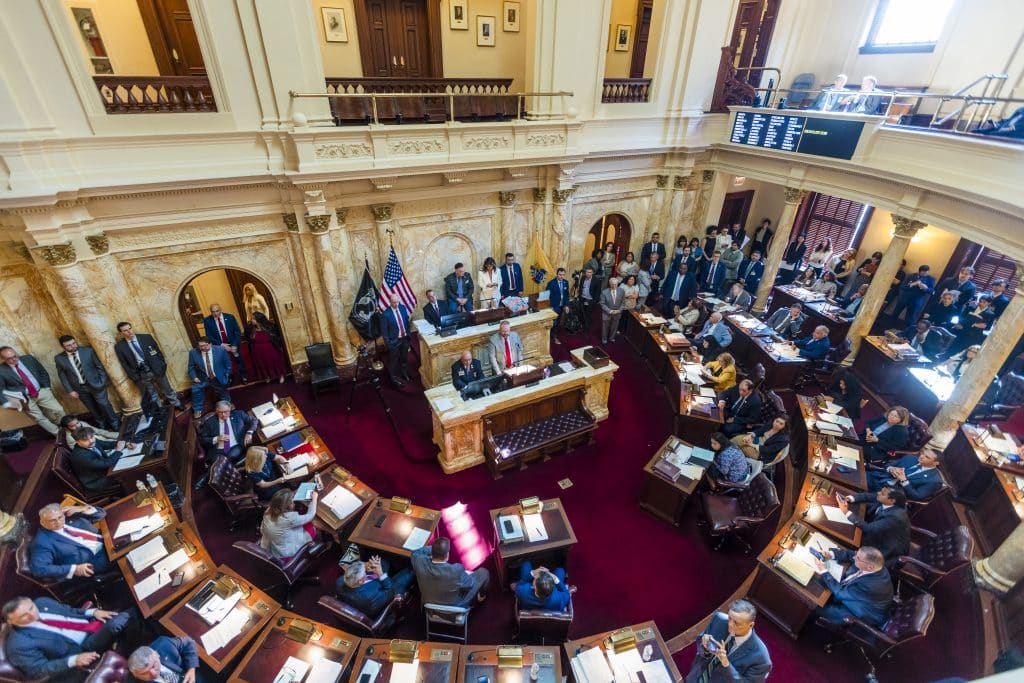
The Assembly unanimously passed the “Power NJ Act” on Tuesday to build new nuclear plants, in advance of a second unanimous vote in the Senate. The bill now goes to Gov. Mikie Sherrill for her signature. Photo credit: Suzette Lucas / NJ State House News Service
New Jersey set the stage for a more nuclear future. The Legislature unanimously passed the “Power NJ Act” on Tuesday, as the state attempts to decrease rising electricity costs spurred in part by the rapid growth of data centers.
“It’s an investment for the future,” said Assembly Member Robert Karabinchak, a Democrat from Edison.
“This will help our ratepayers because it’s a stable source of energy that goes on for 40 years,” added Karabinchak, one of three primary sponsors of the bill.
The “Power NJ Act,” A4881/S4296, aims to increase energy by building new nuclear plants throughout the state. It directs the Board of Public Utilities, in collaboration with the New Jersey Economic Development Authority, to establish a program that plans and creates more advanced nuclear energy facilities.
Currently, New Jersey has three nuclear reactors, all at least 40 years old, located in Salem County and owned and operated by PSEG.
In January of this year, Gov. Mikie Sherrill declared a state of emergency on utility costs following a reported 17% average increase in household electricity costs from 2024 to 2025. In response to the emergency, the Governor signed an executive order that established a Nuclear Task Force to coordinate efforts for the development of new nuclear generation facilities.
Later, in April, Sherrill signed legislation lifting the decades-old moratorium on building new nuclear plants, paving the way for the creation of new nuclear facilities.
Although the “Power NJ Act” intends to reduce energy costs, its opponents argue that the bill might have the opposite effect, expressing concern about the lack of transparency regarding how much the bill, whose fiscal estimate marks its expenditures as indeterminate, will cost New Jersey ratepayers.
“This is such a massive bill with such massive consequences that it could potentially cost the ratepayers in New Jersey up to $6 billion dollars,” said Dena Mottola-Jaborska, executive director of the nonprofit New Jersey Citizen Action, in a hearing last week.
“We don’t know what the cost of this bill actually is,” said Mottola-Jaborska. “Nobody can present information about what actually is going to be the cost that is going to be passed on to the ratepayers.”
“We can’t sign a blank check to build a nuclear power plant when we’re already struggling to pay the bill we have in front of us,” said Crystal McDonald, senior associate state director of advocacy for AARP New Jersey.
Several opponents of the bill expressed their desire for the state to instead invest in alternative energy sources like geothermal, hydro, wind, and solar.
“I put solar on my roof, and the only reason I could put solar on my roof is because there was a federal program that took $10,000 off the cost of going solar,” said Amy Goldsmith, New Jersey state director of Clean Water Action. “Normally my bill is about $200 or more…I got billed $5 last month.”
In addition to affordability, opponents warned the benefits are decades away.
“It takes 10-20 years, best case, to get nukes…the affordability crisis is now,” said David Pringle from Empower NJ, a coalition of advocacy groups. “This bill will not help the affordability crisis now; it will absolutely exacerbate it.”
Assembly Member David Bailey Jr., a Democrat from Woodstown and sponsor of the bill, said last week. “Nuclear is the best long-term solution for fixing [the energy] shortage.”
“We are here with a shared goal: lower the cost of power for our constituents,” Bailey continued. “And that is not possible unless New Jersey invests in the new generation and gets more energy onto the grid.”
Existing nuclear power in the state currently accounts for more than 40% of electricity generation, according to PSEG.
The act passed unanimously with bipartisan support, with a vote of 72-0-2 in the Assembly and 40-0 in the Senate, and awaits the governor’s signature.
This article was written by Miniya Malone, courtesy of the NJ State House News Service