
Fashion as Armor. Qaysean Williams is designing a world where everyone gets to shine
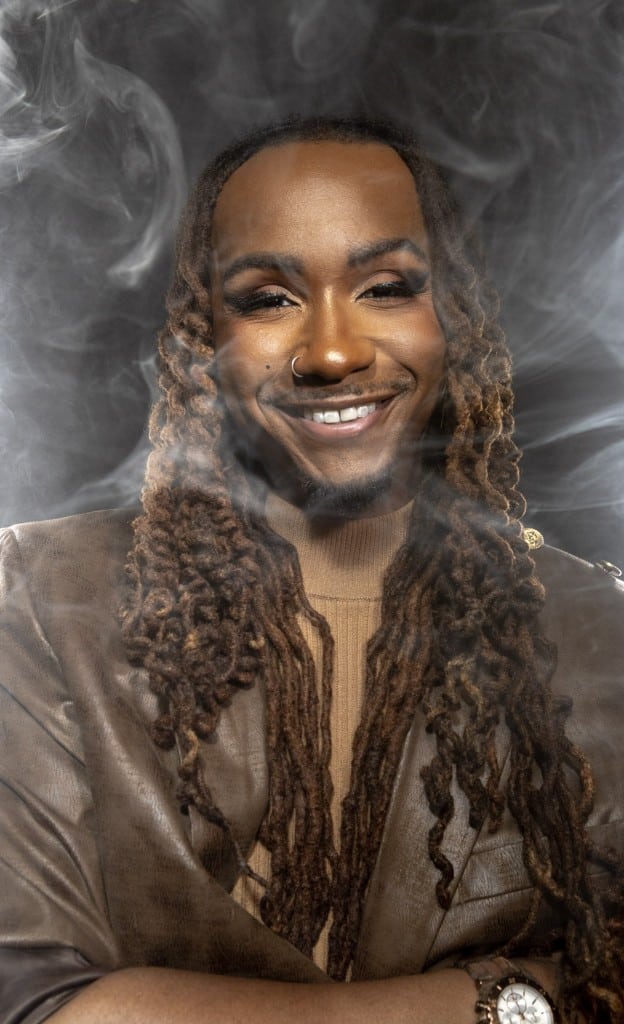
What do eating on the move, mutant superheroes, and high fashion have in common? At first glance, almost nothing. But for designer Qaysean Williams, they are threads in the same garment—one about adaptation, self-expression, and the power of being seen.
Born and raised in Trenton with Erb’s palsy, Williams grew up feeling like a superhero in a world that wasn’t designed for him—acutely aware that his arm was different, yet rarely seeing that difference reflected in the world around him. Perhaps that is why he found such a natural connection to the superheroes who filled his childhood imagination.
“I grew up watching X-Men, Batman, and I am a big Marvel fan,” Williams said with a wide smile.
It isn’t difficult to see the connection. The X-Men were different. They were outsiders. They were often misunderstood and ostracized. “I remember people looking at me and making remarks,” he recalled of his time growing up.
Then at 14, Williams walked into a youth fashion show carrying just a vision and an interest in clothing, and walked out having glimpsed a version of himself he hadn’t known was possible.
“That was the first time where I did not think about my arm being part of the equation,” he said. “I got so lost into producing the show. I finally felt seen.”
Fashion, he says, “literally landed in my lap.”
What started as an opportunity to belong became a calling.
“Unknowingly, it allowed me to express that anything is possible,” Williams said. “I was just trying to do something. I was just trying to survive in this world.”
That message to trust yourself, have faith, but put in the work, has become part of the philosophy behind his work.
Williams is now known as the “One-Hand Sewing Man,” a title he coined himself. But it isn’t simply a catchy name. It is a declaration of independence. “I wanted to reclaim my power. At first a lot of people did not think I made my own clothing,” he said. “That was a call for me to start to record the process.”
And the process is anything but conventional.
Williams attended Mercer County Community College, where he earned his associate degree in fashion, before continuing to Montclair State University, where he earned a bachelor’s degree in fashion studies. At Montclair, Williams encountered a new challenge: many of the techniques he was taught were traditionally designed for two-handed work.
“It was new,” he said. So Williams adapted.
When creating a gown that can stretch 50 or 60 inches long, he may use his entire body, his legs, or a combination of pushing and pulling techniques to accomplish what another designer might do with two hands.
“It makes my brain sharper,” he said. “So I try a bunch of new things. It’s all for a bigger purpose.”
That spirit of adaptation has become central to Williams’ vision for fashion.
Adaptive fashion, he explains, is fashion designed with people with disabilities in mind. But he believes the industry still has a long way to go.
“When I step into a space, I am coming into a space that doesn’t represent me as much. When I am creating, I am thinking about evolution and inclusion. For so long, we have been stuck in beauty standard boxes and able-bodied boxes. People with disabilities want to look fabulous too. I want to be in my garments without being stressed.”
For Williams, adaptive fashion isn’t an abstract idea. Its importance can be felt in the smallest moments of everyday life.
“You can’t walk and eat,” Williams said, explaining the everyday challenges that can arise when clothing isn’t designed with accessibility in mind. Fashion should not create another obstacle because, in his words, “when you look good, you feel good.”
Williams’ designs blend fantasy fashion with streetwear, drawing on the superhero stories that captivated him as a child. It’s a style rooted in imagination—and one that reflects his ultimate goal: bringing his journey full circle by designing the clothes worn by the very heroes who inspired him.
“I see my fashion as armor. When you put it on, it’s like armor.”
For now, his brand, Haus of Manikin, allows him to explore that idea through custom fantasy pieces as well as more wearable streetwear. His atelier service provides customers with the pieces they want without forcing Williams to compromise his creative vision. But for Williams, the work has never been solely about the clothes. It’s about what becomes possible when people are given the freedom to see themselves differently.
And that is the message he wants the younger generation of Trentonians to carry with them: their circumstances do not have to define their futures.
“The main thing I want them to see is that it is possible,” he said. “It’s more than possible. You deserve to be in every room and every space you enter and that you have something to say.”
He encourages young people to use the resources around them, find their individuality and, perhaps most importantly, ask for what they want.
“Uniformity is cool when it is time to push the bigger message, but individuality is key,” Williams said.
Williams’ ambitions are anything but small. He envisions a fully functioning atelier with a design team, product lines in stores, major television and film opportunities, appearances at the Met Gala and CFDA Fashion Awards, and, of course, his name rolling through the credits of major films.
He also wants to establish foundations in Trenton and other cities to cultivate the next generation of designers.
For Williams, however, the biggest answer may be one he discovered as a teenager: Be yourself. Do the work. Find your people. And never be afraid to walk into the room.
Even if you have to make your own armor first.
Originally published in Trenton Journal’s Fall 2026 Collector’s Edition. Purchase your copy at Classics Used Book Store, Out of Step Boutique, or TrentonJournal.com.


