Exploring Afrofuturism: Clifford Ward’s Visionary Exhibit at Artworks Trenton
Through April 12, Artworks Trenton is proud to host “I’ll Make Me a World, Prologue,” an exhibit of work by Clifford Ward, curated by Artworks’ Addison Vincent. Mr. Ward, originally from Jersey City, began as an apprentice at Grounds for Sculpture, and has had his studio there since 1998. His work is an endlessly creative mix of painting, sculpture, and collage, centering around an aesthetic of “Afrofuturism.” The term was coined in 1993 by the writer Mark Dery to refer to a movement at the intersection of the African Diaspora culture and science, technology, and science fiction. In essence, Afrofuturism existed long before it earned the name. Some would say it dates back to Colonial America, with such figures as Benjamin Banneker, the Black scientist who used his platform to challenge misconceptions of white superiority. Twentieth-century luminaries included flamboyant jazz artist Sun Ra who came on the scene in the 50s and drew on both African culture and science fiction for inspiration, and the more recent science fiction writer Octavia Butler. The 80s film Brother from Another Planet, though written and directed by John Sayles (who is white), is a comical but thoughtful science fiction piece whose Black extraterrestrial protagonist lands in Harlem and reflects on humanity, with its racism, inequality, and other discontents. Ward cites the recent Black Panther as the epitome of Afrofuturism in film — where African culture is exaggerated and projected into the future.
Ward tells us, “Afrofuturism is a term that’s been applied to my art. I had been doing this kind of work for some time, before I’d ever heard the term. We’re reclaiming our culture and bringing it into the future — the overall culture of the African Diaspora. We’re taking that and reinventing and reclaiming symbols, history, and stories from the past, connecting them with technology and more or less modernizing them. I take a lot of influences from cultures all over Africa, ranging from Egypt to places like Angola in Central Africa. I do a lot of Nkisi figures, inspired by spirit-invested objects in the art of Central Africa, with nails used as decorative elements. I use old-style square flooring nails to create patterns. One of the symbols I’ve used is the Ankh, the Egyptian life symbol, though some of the patterns are purely decorative.”
Addison Vincent of Artworks tells us, “We could not be more delighted to host Clifford’s exhibit! The full title, ‘I’ll Make Me a World, Prologue’ is inspired by the creativity of his work over many years. He includes the word Prologue because it’s a preview of his full exhibition at Grounds for Sculpture, coming up this spring. It speaks to the power of self-determination, realization, and the creation of future narratives. I curated this exhibition as a testament to Clifford’s ability to envision and construct spaces where cultural heritage and forward-looking ideas intersect. Viewers are invited to journey through the narratives Clifford has created, where the boundaries of time and space are fluid, and where the future is a canvas for cultural expression and identity. The show is a celebration of the boundless potential of Afrofuturistic art and Clifford’s continued contributions to inspire, challenge, educate and transform.”

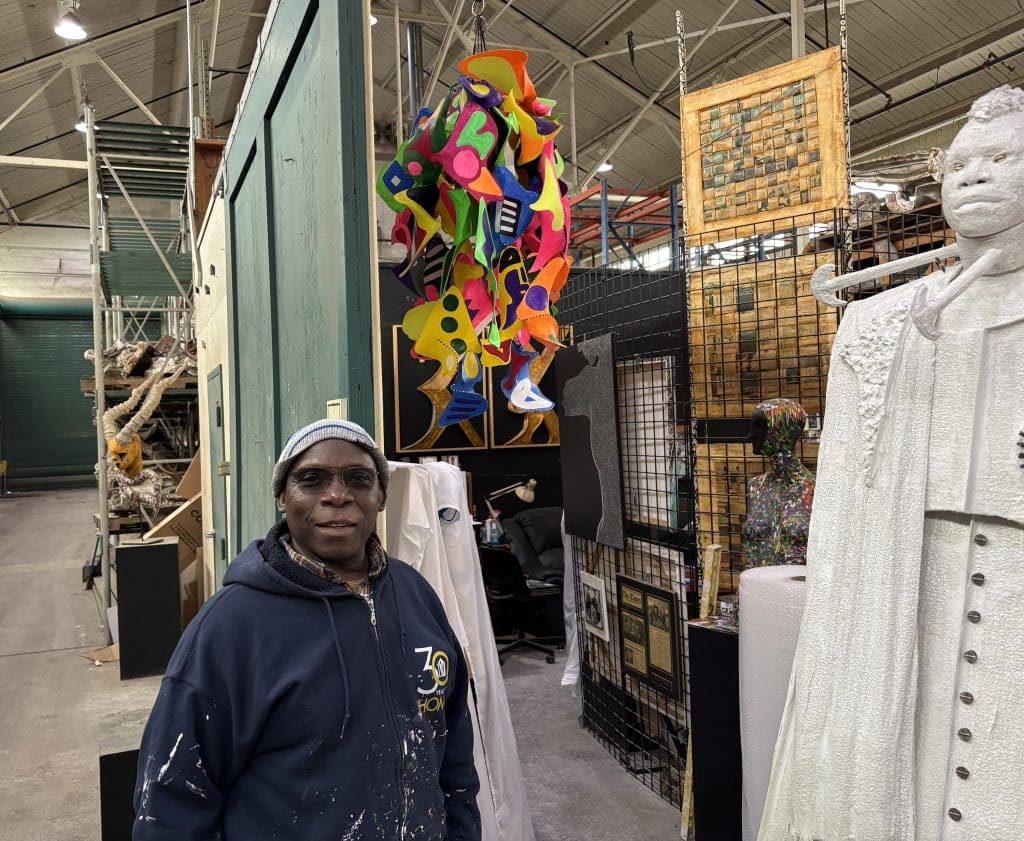
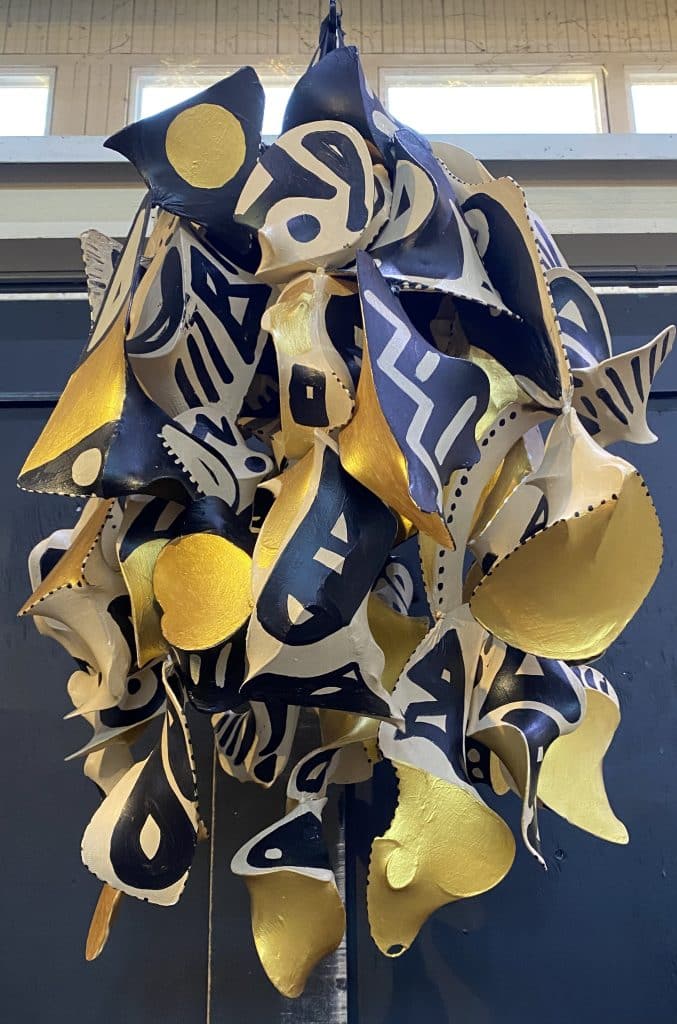
Trenton Journal met with Clifford Ward in his studio at Grounds for Sculpture, where he commutes from his home in downtown Philadelphia. Like the exhibit at Artworks, his studio is a feast for the eyes: No matter where you look, there is something fascinating. The pieces all belong together but they show different directions for one artist’s creative impulse, whether they are paintings on a wall or sculptures suspended from the ceiling. His “Fluidity” series consists of organic forms that he creates using stockings stretched over wire coat hangers that he has bent and curved into swirling shapes; he then coats them with gesso (artists’ acrylic primer) and paints them with acrylic, then hangs them together from above as mobiles. One is especially drawn to Ward’s “Guardian” figures in his “Animism” series: twenty-four sculptures with a humanoid presence. They are life-size and larger, and they project a sense of dignity and strength. Many of them have faces that the artist creates by casting his face in plaster, which he changes freely for different pieces. “Sometimes people see them and they see that it’s me, but often they don’t.” For some of their eyes, Ward uses cowrie shells — often used in African art and jewelry, and some cultures used as currency. “The cowrie shells change the entire essence of the face. They have a special meaning, especially when you place them in the eyes — they signify insight and perspective. That’s pretty much how I use them.” A viewer might imagine the Guardians looking back at them or looking into the future — as if we are invited to have a dialogue with the figures. The Guardians are not strictly human figures. Some of their limbs or other body parts appear more angular and mechanical, perhaps like those of robots in a science fiction story; but at the same time, they hold the memory of Africa and the slave trade. The Guardians are paired, with each pair displaying similar but varying characteristics, like mirror images. Each is unique, with its surface treatment of patterns created with objects such as nails, ceramic cups, small mirrors, or cloth. Among the most disturbing images are slave collars on one pair: Clifford described these torturous devices as steel collars with four long rods with hooks on the ends that could break the wearer’s neck and would severely hinder any efforts to escape. “I’m realizing most of my work is duplicated in different ways — it gives me the chance to experiment with variations in color and other aspects of the work.”
Ward’s show at Artworks is well worth a visit, and the upcoming exhibit at Grounds for Sculpture promises to command attention around the region.