From Revolutionary documents to family histories, Trenton’s past lives on in the Trentoniana Collection
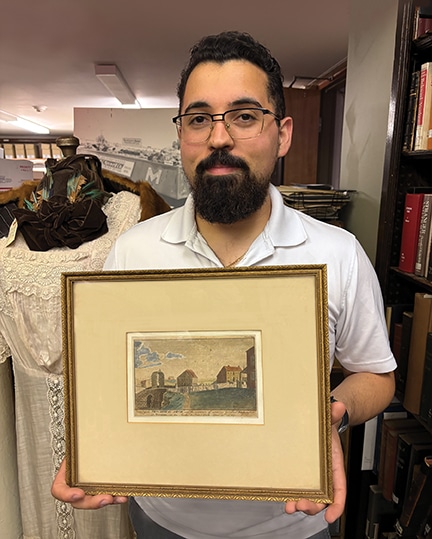
Since its construction in 1902, the Trenton Free Public Library has been a center of the city’s cultural life, offering a wide assortment of services for all ages, interests, and members of the community. The library established its Trentoniana Collection in 1906 to preserve and share documents, images, and artifacts for residents and outside researchers with an interest in Trenton’s centuries of still-evolving history.
Local History Librarian Robert Schenker earned his master’s degree in information sciences from Rutgers University in 2022, with a special focus on archives and preservation. He took over supervision of the Trentoniana Collection in 2024. Few of us are lucky enough to have such enthusiasm for our jobs as Mr. Schenker has for his. “I grew up with an obsession with history, so this is not just a career; it’s a life,” he says. “People come here with all sorts of interesting or unusual questions on Trenton history. I don’t always know the answer right off, but I know the process for looking it up. That’s what the archive is for. We have information on the big stories and the broad outline of history, but the collection also touches on what I’d call microhistories — subjects like teacups, or colonial-era privateers.”
Currently, he is working on creating a full index with searchable spreadsheets to augment the collection’s card catalog systems and streamline the process for tracking down information. The collection boasts roughly 250,000 images and more than 200,000 documents, covering the span from before the American Revolution to the current day.
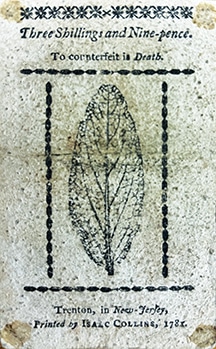
Here you can find a handwritten proclamation from William Franklin, son of Ben. Father and son had their disagreements: as one of the Founding Fathers, Ben was dismayed that his son William was the loyalist Governor of New Jersey. During the Revolution, the younger Franklin was rivaled by William Livingston, a Founding Father and the first Governor of New Jersey under the new government. There is a piece of early currency: a “Three Shillings and Nine-pence” note (with the ominous warning, “To counterfeit is Death.”) printed in Trenton by Isaac Collins in 1781, long before national currency became the norm. Also of interest is the image on this note: it was one of a number of currencies that bore an impression derived from a leaf. Long before fingerprints became a tool for law enforcement, the naturally unique patterns of leaves were used to identify legitimate currency and frustrate the counterfeiters who were undaunted by the threat of death. There are accounts from British and Hessian soldiers telling of their awe at seeing the natural beauty of New Jersey at the time. Moving into the 1800s, there is a book commemorating the Marquis de Lafayette’s 1824 visit to America after his invaluable efforts for American independence, including a speech by Trenton’s mayor at the time.
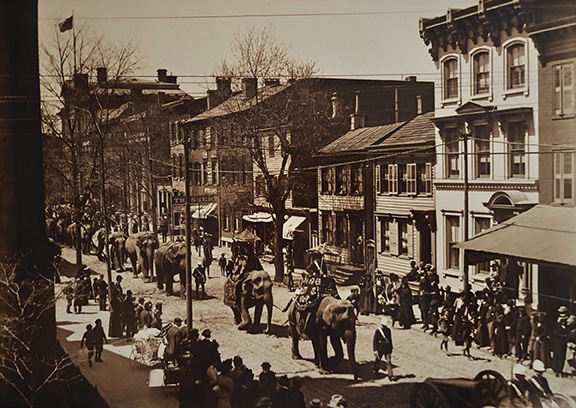
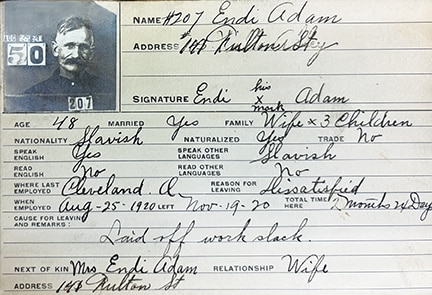
Once Trenton’s biggest employer, the Roebling Company is well-documented among Trentoniana’s substantial records. The Roebling Company pioneered and developed wire rope in the 1800s, and famously built the Brooklyn Bridge and many other suspension bridges. Library patrons can explore Roebling’s day-to-day operations with its price lists and information on both management and factory employees, whose ID cards show a profile of ethnic history in the city. “It’s history you can touch. For me, that’s the best kind of history,” Robert explains. The collection also includes much information on the multiple ceramics companies once in Trenton, along with samples of their cups, plates, and other fine porcelain.
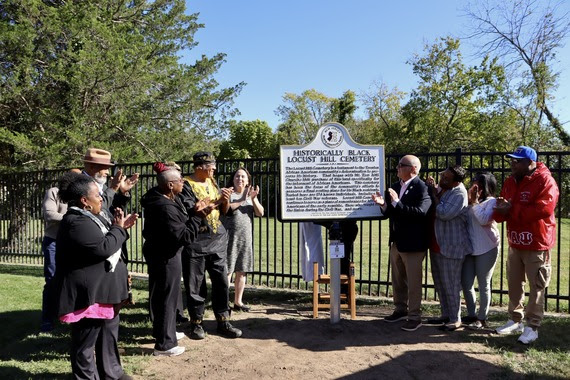
The collection holds documents relating to Black history in New Jersey, the last northern state to officially abolish slavery. There are records from before the Civil War, as well as more recent events in the struggle for civil rights. Notable among these is the 1944 Hedgepeth-Williams case (see Trenton Journal, 2023), taken as a precedent for school desegregation in 1954’s Brown v. Board of Education decision. In the 1960s and 1970s, Mayor Arthur Holland’s Committee on Unity, plus statewide hearings on anti-discrimination measures, were documented. Mayor Holland’s widow passed on a large number of these records to the library.
Many Trentonians are familiar with the mural by N.C. Wyeth, “Reception to Washington on April 21, 1789,” originally commissioned by Trenton’s First Mechanics National Bank and later donated by Wells Fargo to Thomas Edison State University on West State Street. N.C. Wyeth, father of artist Andrew Wyeth, was a luminary of the great age of illustration in the early 20th century. The Trentoniana Collection has the original wooden arch that was erected for Washington’s 1789 visit, several prints showing different versions of the scene, and, most interestingly, 1930s correspondence between N.C. Wyeth and Howard Hughes (not the eccentric millionaire of “Spruce Goose” fame), then Director of the Trenton Free Public Library. The library assisted Wyeth with research to develop his painting.
Newspaper clippings and police records from the 19th and 20th centuries provide a view into the social history around town. Here you can find stories of illegal drinking and speakeasies during Prohibition, gambling, prostitution, and organized crime activity. Robert displays a police blotter book from 1892-1893 that lists various events, a “total index of all of the complaints, incidents, and things noted by police, such as missing persons, a fire, a burglary, or sometimes a meeting of socialists or anarchists, or a gathering of a community, say a Jewish community, or Hungarians, Polish or Italians. . . . This is an example of the type of public history resource that we have here,” Schenker told the Trenton Journal. “We’re able to see the everyday lives of people who lived in Trenton, whatever their ethnicity, whether or not they spoke English or were born here. Whether or not their information exists anywhere else, it exists here. We can make their stories available. This is just an incredible resource. Through these accounts, we’re able to learn the names and the actions of these people who lived here over a century ago. More likely than not, most of us had ancestors who were not titans of industry, or great generals, or people who would appear in the history books. Most just were regular people, working regular jobs, with their highs and lows.”
This article originally appeared in Trenton Journal’s Fall 2026 Collector’s Edition, “Standing On Business.” Celebrate Trenton’s entrepreneurs and local stories by purchasing your copy at Classics Used Book Store, Out of Step Boutique at the Trenton Farmers Market, or online at TrentonJournal.com.