Trenton Is Moving Forward — And the Results Are Becoming Impossible to Ignore
When people talk about Trenton, they often talk about what the city used to be — or what they think it is not.
For too long, conversations about New Jersey’s Capital City have focused more on its challenges than on its potential. Scroll through social media long enough, and you will find people insisting nothing ever changes here. But that narrative increasingly collides with reality.
Because if you walk through our neighborhoods, attend a City Council meeting, visit our parks, or simply look at the construction and investment happening throughout Trenton, you will see something very different: A city in forward motion. And a city proving that progress is not merely a promise — it is happening.
Over the last several years, Trenton has aggressively competed for outside investment and forged partnerships at every level of government. Those efforts are delivering tangible results across our city. In partnership with our federal, state, county, nonprofit, and community partners — and with the support and approval of City Council — Trenton has secured:
• $7 million from the New Jersey Economic Development Authority for the restoration of the historic Roebling Wire Works and Eagle Tavern
• $3 million from the New Jersey Historic Trust for the restoration of City Hall
• More than $2 million from the Department of Transportation for the Marine Terminal Trail
• $2 million in federal funding for Assunpink Greenway Park
• $2 million to support restoration of the Carver Center
• Millions more for parks, housing, infrastructure, and neighborhood revitalization projects throughout the city
Those investments are not abstract promises or plans sitting on paper. They are visible signs of a city transforming in real time. And others are beginning to take notice. This year, Moody’s upgraded Trenton’s credit outlook, recognizing stronger fiscal management and growing financial stability. That matters. Confidence attracts investment. Confidence lowers borrowing costs. And confidence sends a message that Trenton is moving in the right direction.
Housing redevelopment is also accelerating. For decades, Trenton struggled with vacant lots, abandoned properties, stalled development projects, and disinvestment that hollowed out entire blocks. Today, long-vacant homes are being restored across all four wards. Council has approved hundreds of property transfers to local developers and first-time homebuyers. Major projects are advancing on South Broad Street, Greenwood Avenue, and East State Street. The city recently approved development of its first transit village near the Trenton Transit Center — the first stop on the Northeast Corridor.
We are no longer simply talking about what Trenton could become. We are rebuilding it. Alongside that progress, public safety remains a central priority. Last year, violent crime in Trenton dropped by more than 16 percent, while robberies declined by 28 percent. This year, homicides are at an all-time low. Police confiscated more than 300 illegal firearms, expanded community policing efforts, and continued implementing reforms recommended by the U.S. Department of Justice.
At the same time, the City has continued investing in youth programs, community street teams, recreation, and mental health response initiatives because we understand a simple truth: We cannot arrest our way out of every challenge. Safer cities are built not only through policing, but through opportunity, recreation, stability, and neighborhood investment. That philosophy extends to our parks and recreation system as well.
Trenton has more than 60 parks, and we have made it a priority to modernize playgrounds, athletic facilities, and public spaces across every ward. Families should not have to leave Trenton to find safe places for children to play or communities to gather.
The same is true for infrastructure. No issue has tested this administration more than Trenton Water Works. We inherited decades of deferred investment and aging infrastructure, but we chose to confront those challenges directly. Through litigation and advocacy, Trenton Water Works secured more than $5.5 million through the national PFAS settlement. More importantly, the utility is now undertaking a $763 million Capital Improvement Plan that will modernize treatment systems, replace aging infrastructure, continue lead service line removal, and strengthen the long-term reliability of our regional water system.
More than 10,000 lead service lines have already been replaced free of charge to residents. That is the type of long-term investment cities make when they are serious about their future. But perhaps most importantly, Trenton’s progress is not simply measured in ribbon cuttings or development announcements.
It is measured in whether residents feel safer. Whether neighborhoods feel cleaner. Whether seniors receive services. Whether children have parks to play in. Whether families can envision a future here. And none of this happens alone. Trenton is a city built on partnerships.
The progress we are seeing would not be possible without collaboration between City Council, county leadership, state agencies, federal partners, nonprofits, faith institutions, neighborhood organizations, and residents themselves. Government alone cannot rebuild a city. The true strength of Trenton has always been its people. This year, as the nation prepares to celebrate America’s 250th anniversary, Trenton stands once again at the center of the American story.
In December 1776, the Revolution was collapsing. George Washington crossed the Delaware River and marched into Trenton, where the Continental Army secured its first major victory. Without Trenton, there may not have been a United States of America.
But Trenton’s story did not end in 1776. It continues every day through the residents who choose to believe in this city. Through the families building lives here. Through immigrants seeking opportunity. Through teachers, first responders, small business owners, clergy, volunteers, and young people who continue showing up for their neighborhoods and for one another.
The challenges facing Trenton are real. No one denies that. But so is the progress. The State of our City is stronger than it was yesterday, more confident than it was a year ago, and still moving forward. And for the first time in a long time, more people are beginning to see not only where Trenton has been — but where it is going.
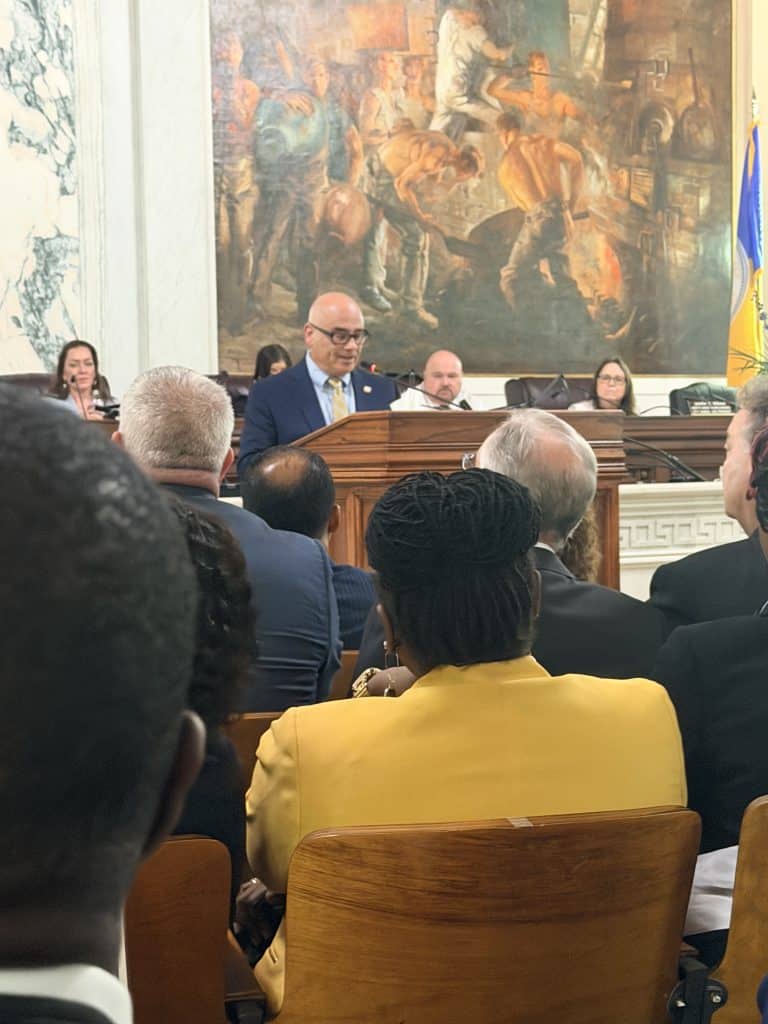
W. Reed Gusciora serves as the 49th Mayor of Trenton. This op-ed is adapted from his 2026 State of the City Address delivered before the Trenton City Council.