From Trenton to Wall Street and Back Again: Maurice Coleman’s advice for entrepreneurs seeking capital
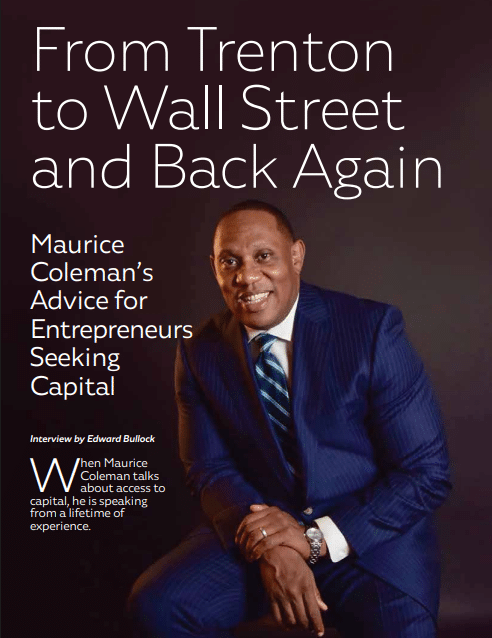
When Maurice Coleman talks about access to capital, he is speaking from a lifetime of experience.
Today, Coleman leads a national lending and investment platform responsible for deploying billions of dollars into affordable housing, economic development, small businesses, and underserved communities across America. Yet his journey began in Trenton, New Jersey, where he learned firsthand how access to opportunity, and often the lack of it, can shape the future of individuals, families, and neighborhoods.
During a recent conversation, Trenton Journal asked Coleman what advice he would give aspiring entrepreneurs in Trenton and other low-to-moderate income communities who are trying to secure financing to start or grow a business. His response was both practical and deeply personal.
A Good Idea Is Only the Beginning
“The first thing entrepreneurs need to understand,” Coleman told me, “is that lenders are financing a business model, not just an idea.”
Too often, he explained, business owners spend months refining a product or service but struggle to explain how the business will generate revenue, manage expenses, and ultimately repay financing.
“Lenders want to know who your customers are, what problem you’re solving, how cash flows through your business, and how financing will help you achieve your goals,” he said. “A great idea without a clear plan is still a risky investment.”
For Coleman, the strongest entrepreneurs are those who combine vision with discipline. They understand that success is built not only on innovation, but also on execution.
Capital Comes in Many Forms
One of the biggest mistakes Coleman sees entrepreneurs make is relying on a single source of financing.
“There are more resources available today than ever before,” he said. “Traditional banks are important, but so are SBA programs, Community Development Financial Institutions, Small Business Development Centers, economic development agencies, and other mission-driven lenders.”
The most successful entrepreneurs, he noted, understand how to build what investors call a “capital stack” by combining grants, equity, community development financing, and traditional debt. “The entrepreneur who understands the entire financing ecosystem has a tremendous advantage,” Coleman said.
Build Credit Before You Need It
Preparation, according to Coleman, is often the difference between opportunity seized and opportunity missed.
“Too many people wait until they need financing before they start building their financial foundation,” he explained.
That foundation includes establishing banking relationships, separating personal and business finances, monitoring credit, and developing a track record of responsible financial management.
“For startups especially, lenders are evaluating the entrepreneur as much as the business,” Coleman said. “Strong credit demonstrates reliability, discipline, and commitment.”
Businesses Should Create More Than Profit
Having spent decades financing community development projects, Coleman believes the most successful businesses generate both financial and social returns.
“In cities like Trenton, businesses are more than profit centers. They are engines of opportunity,” he said.
He encourages entrepreneurs to think beyond earnings and consider how their businesses create jobs, support workforce development, revitalize neighborhoods, and strengthen local economies.
“When a business creates meaningful community impact, additional financing opportunities often emerge because lenders and investors recognize the broader value being created,” Coleman explained.
Relationships Still Matter
Despite advances in technology and artificial intelligence, Coleman remains convinced that banking is, at its core, a relationship business. “The best time to meet a banker is before you need money,” he told me.
He encourages entrepreneurs to build relationships with bankers, advisors, economic development organizations, and fellow business owners long before they apply for financing.
“Trust and credibility matter,” Coleman said. “People pay you back. Spreadsheets don’t. Investors fund businesses, but they ultimately place their confidence in people.”
The Power of Persistence
As our conversation came to a close, Coleman offered one final lesson.
“Never let a lender’s first ‘no’ become your final answer.”
Throughout his career, he has seen countless entrepreneurs succeed after an initial rejection.
“In fact,” he said with a smile, “I’ve always believed that ‘No’ can mean N.O. – Next Opportunity.”
The most successful business owners, he explained, do not walk away discouraged. Instead, they ask a different question:
“What needs to change to get to yes?”
Then they strengthen their plan, sharpen their execution, build stronger relationships, and return better prepared.
For Coleman, that philosophy reflects the spirit of Trenton itself. “Resilience has always been one of this city’s greatest strengths,” he said. “When preparation meets perseverance, opportunity usually follows.”
This article first appeared in the third print issue of Trenton Journal magazine, which celebrates local entrepreneurs. Get your copy now at select Out of Step Off Beat Boutique & General Store, Classics Used Book Store, and online at TrentonJournal.com.