Joseph A. Halsey spotlights new documentary on men’s mental health

Since founding the James R. Halsey Foundation of the Arts in 2017, CEO Joseph A. Halsey has worked to empower local youth through filmmaking and creative mentorship in Trenton. Now, Halsey is turning the camera toward one of the most prominent challenges facing our society today: Men’s Mental Health. With insight from professionals in the industry and candid stories from local youth, the foundation’s new documentary tackles men’s mental health head-on—proving once again how storytelling can spark vital community conversations. The Trenton Journal caught up with Halsey and spoke about the impact of the foundation, his passion for young people pursuing the arts, and the importance of men’s mental health.
What was your journey that led to becoming an independent filmmaker and working with the youth of Trenton?
Everything happened in 2017. We did a documentary with youth who were on probation as nonviolent offenders. I think it was Mayor Eric Jackson who asked kids what they would do if they were mayor of the city. When I heard their answers, I went, “Wow!” Six months later, we had a documentary, and all of a sudden, I became a documentary filmmaker. One of the things we found through doing this documentary was that every kid was interested in media of some sort—whether it was influencing on YouTube, making music videos, or being in fashion. From my experience in the film industry, I felt that the best way to teach all areas of media was through the art of independent filmmaking. So, we started a class at the Sam Naples Center. Eight years later, here we are, serving 100 kids a week through our summer programming. We also just taught our first documentary class where the kids served as producers in addition to making the film.
“What is your approach to teaching your students in the ever-changing media landscape?”
We have a philosophy here where we are very hands-on. To teach film and media, you have to put your hands on everything. It’s a trade, not just a class. If you’re not actively in it, how do you learn it? Right? It’s like swinging a hammer—you’re never going to learn how to swing a hammer if someone just keeps showing you how to do it. You have to really pick up that hammer and start working with it until you get better.
What is the inspiration behind the name “James R. Halsey Foundation of the Arts?”
When it came time to officially become a 501(c)(3), we were trying to figure out a name, and I just said, “You know what? Let’s name it after Pop.” Pop was my coach when we were younger. He always took the Bad News Bears kids and always got them to a really great spot, giving them confidence. I felt we were going to be able to do the same thing, and we did. So, that’s where we are now. We’re serving kids who are on ankle bracelets and facing a return to juvenile detention, kids heading off to Ivy League schools, and everybody in between.
Your latest project is a documentary on men’s mental health. What led you to explore this topic?
We have a premiere night every year for our students to showcase their work. We do it film-festival style, so we show four films, with the documentary highlighted. We have three student short films—about seven to 10 minutes long—that they wrote, filmed, and really got in the trenches for. Their work is just incredible.
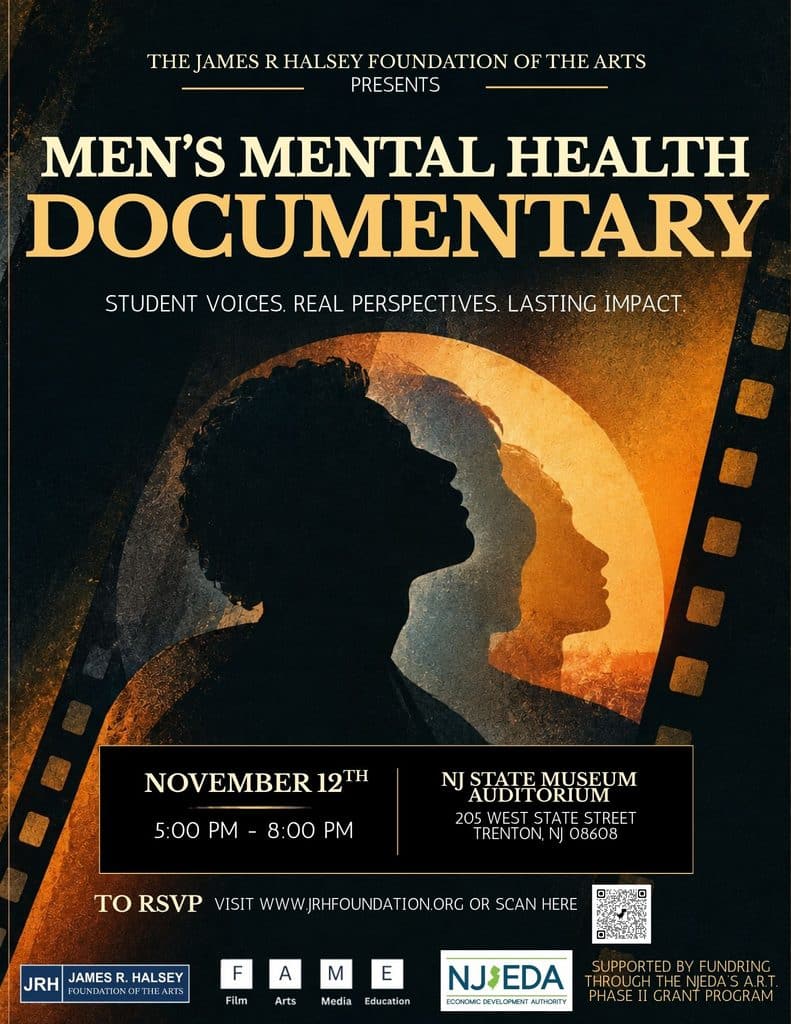
We made the documentary this year as part of our NJEDA Arts Phase Two grant. We got a big grant to really get going with them, and I can’t thank them enough—we rose to another level this past year. Part of that growth comes from teaching in juvenile detention facilities, working with the Annie E. Casey Foundation in D.C., and running a men’s mental health group here every Monday night for young men, with attendees ranging from 16 to 60. When working with young men who are justice-involved, aside from meeting their direct needs and mentoring, you have to work through that trauma. It’s hard to get past that and move forward without addressing it. So, as I was sitting there thinking of a documentary to make—and knowing I had to teach a documentary class—I thought, Why don’t we do both? Let’s learn more about men’s mental health to educate me, and let’s have the students help tell that story. You know, 60% of all suicides are successful among men, and most of the violence in the country is done by men. In the doc, it’s said, ‘You got to touch the virus to come up with a vaccine. That’s so profound to me.
How did working on the documentary impact the students?
Looking at the documentary and what it did for them, it really was an education. There’s one student who—without getting too far into their personal life—went through a traumatic incident. When they finished working on this documentary, they said, ‘No, I’m looking at it very differently now. I’m looking at my situation differently because of what I heard.’ That right there—that’s our win. The film is great, but our real win is that a young person can work through something.”
Lastly, what do you want viewers to take away from the film?
Well, first, I want them to take away how great the kids are. The mission is always to highlight these young people and how brilliant they are. You know, men account for a disproportionately high percentage of suicides—around 60% or more—and that’s a massive ratio. Also, the majority of violence in this country is committed by men, which is rooted in trauma. You can’t tell me that everyone sitting in a prison was born a sociopath or a psychopath. This is trauma-based. And I think if we start paying more attention to that with young men, we might see a real slowdown in that.