Former Mayor Palmer calls for two-day Trenton conference to combat violence

The recent mass shootings and continuing violence in our beloved City of Trenton have once again left families grieving, young people traumatized, neighborhoods shaken, and an entire community asking a painful question: What must we do differently to prevent the next tragedy? My heart and prayers are with every victim, every family, every survivor, and every resident affected by these horrific acts.
But compassion must now be accompanied by action. These acts of violence have brought us to a point where we must confront not only the shootings themselves, but the deeper culture of violence, trauma, retaliation, hopelessness, alienation and disconnection that can allow violence to take root.
I have read the recent opinion by Rev. Dr. Charles F. Boyer, calling for the City of Trenton to establish an Office or Department of Violence Prevention and Public Safety. Along with Rev. Dr. Boyer, Lance Lopez, Tracy Syphax, Gene Bouie, and others have passionately expressed similar calls for action.
I believe these voices, grounded in concern for the safety, well-being, and future of Trenton’s residents, deserve serious and immediate consideration. Their collective call should not simply be heard – it should become part of a meaningful conversation about developing a comprehensive and sustainable strategy for preventing violence and strengthening public safety throughout our city. But as we consider the future, we should also remember an important part of Trenton’s own history.
We have done this before —and it worked
One incident that profoundly shook the heart and conscience of our entire city involved a six-year-old child who was simply riding her bicycle when she was caught in the crossfire of a gang-related shooting and shot in the face. An innocent child became the victim of violence she had absolutely nothing to do with.
That horrific moment demanded more than outrage – it demanded action. Police Director Joseph Santiago, Emmanuel Shahid Avraham and I came together with a shared determination to confront the violence head-on. We understood that good and positive law enforcement and credible grassroots leadership had to work together to reach the streets, interrupt the cycle of violence and protect our children.
That tragedy helped strengthen our resolve: no child in Trenton should ever have to fear being shot simply for riding a bicycle in her own community. During my administration as Mayor of Trenton, we developed a two-fold approach to public safety that proved extremely effective to address gang violence and violence in the City of Trenton. It was simple in principle but powerful in practice: strong, positive and professional law enforcement on one side – and strong, credible “street credit”, community-based grassroots intervention on the other. Neither replaced the other. They complemented one another. Those relationships mattered. These were individuals who understood the language, culture, conflicts, and realities of the streets because many had lived them. We learned that effective public safety does not require choosing between police and community. A successful city needs both.
The national gang and violence summit
Recognizing the importance of this approach, our administration partnered with a national network of experienced street organizers and violence-intervention leaders to convene a major three-day Gang and Violence Summit in the City of Trenton held at Shiloh Baptist Church. Together, community leaders, grassroots organizers, credible messengers, formerly involved individuals, clergy, young people, and representatives of street organizations from across the country confronted the problem directly. We did something government must never be afraid to do: We brought the streets into the conversation about saving the streets. We did not simply talk about people. We talked with people. We recognized that individuals who had influence in the streets could use that influence to help stop violence, prevent retaliation, and redirect young people toward something better. From that work emerged an important framework: The Covenant of Peace.
The Covenant of Peace
The “Covenant of Peace” was not simply another government program. It represented a commitment among government, law enforcement, community leadership, street organizations, credible messengers, clergy, families, and young people to work collectively toward reducing violence. Its fundamental principle remains relevant today: The people closest to the problem must become part of the solution. The “Covenant of Peace” helped create relationships across groups that historically did not always communicate with one another. Those relationships gave us another tool for understanding what was happening in our neighborhoods and intervening before conflicts became funerals. Today, Trenton needs that philosophy again. Not as nostalgia. Not as an attempt to recreate the past exactly as it existed. But as a proven principle that can be modernized for the realities confronting Trenton in 2026. I’m calling for a two-day Summit to be held in Trenton sometime in October 2026.
A two-day Trenton Covenant of Peace Conference
I am therefore calling upon the City of Trenton, Mercer County, the State of New Jersey, law enforcement, clergy, community organizations, educators, behavioral-health professionals, returning citizens, youth leaders, street-intervention professionals, street organizations, victims’ advocates, businesses and philanthropic institutions to convene a major two-day working conference: The Trenton Covenant of Peace Violence Prevention & Public Safety Conference. This must not become another conference where people make speeches, take photographs, issue statements and return home. This conference must produce an action plan. At the same time, today’s Trenton Restorative Street Team, Trenton Community Street Team and other organizations currently doing this work must be central participants. This initiative should not replace today’s community organizations. It should unite, strengthen and expand their capacity.
RESTORE THE TWO-FOLD STRATEGY
The foundation of the new strategy should again be clear: One side: strong, positive, law enforcement. Trenton must have professional, constitutional, accountable, and proactive policing capable of protecting residents, investigating shootings, removing dangerous individuals from the streets, and holding those who commit violent crimes accountable. The other side: strong grassroots community intervention. Trenton must simultaneously invest in credible messengers, violence interrupters, street outreach, trauma recovery, youth development, employment, mentoring, reentry, family stabilization, and trusted individuals capable of reaching those at greatest risk.
Law enforcement addresses criminal conduct. Grassroots intervention addresses relationships, thinking, trauma, retaliation, and the conditions surrounding violence. When properly coordinated, these approaches are not competitors. They are two parts of one comprehensive public-safety strategy. That is one of the most important lessons we learned during my administration.
From conference to permanent infrastructure
I support serious consideration of Rev. Boyer’s proposal for a permanent municipal Office of Violence Prevention and Public Safety. The proposed two-day conference should help design that structure and produce a written Trenton Violence Prevention Action Plan addressing violence interruption, trauma response, youth intervention, employment, education, reentry, behavioral health, family support, data, accountability and permanent funding. But whatever structure emerges, it must preserve the balance that proved so important before: strong positive law enforcement where law enforcement is required. Strong community intervention where trust and relationships are required. And genuine cooperation between both where cooperation can save lives.
Trenton can lead again
We have confronted serious challenges before. We learned that City Hall cannot solve street violence by itself. Police cannot solve it alone. Community organizations cannot solve it alone. Clergy cannot solve it alone. Schools cannot solve it alone. Parents cannot solve it alone. But together, we can change the conditions that allow violence to flourish. There are people in our neighborhoods who can make a telephone call at midnight and prevent something from happening at 1:00 a.m. There are formerly incarcerated men and women who can look a young person in the eyes and speak with an authenticity that cannot be manufactured. There are police officers who know our neighborhoods and want relationships with residents built on mutual respect. There are educators, clergy, counselors, business owners, mothers, fathers, and young people who desperately want something better for Trenton. Our responsibility is to bring those forces together. That was the power behind our earlier approach. That was the promise of the Covenant of Peace. And that is why I believe it is time to bring that covenant back – modernized, expanded, properly funded, and built to last. The families burying loved ones do not need another temporary response.
Our young people do not need another promise. Our neighborhoods do not need another press conference followed by silence. They need leadership. They need resources. They need accountability. They need opportunity. And they need hope. Peace cannot simply be imposed upon a community. Peace must be built with the community. Let us restore the two-fold strategy that taught us this fundamental lesson: strong, positive law enforcement. Strong, grassroots leadership. One Covenant of peace. One Trenton. Let us come together with one overriding mission: stop the next shooting before it happens and give our young people something greater to live for. The time to act is now.
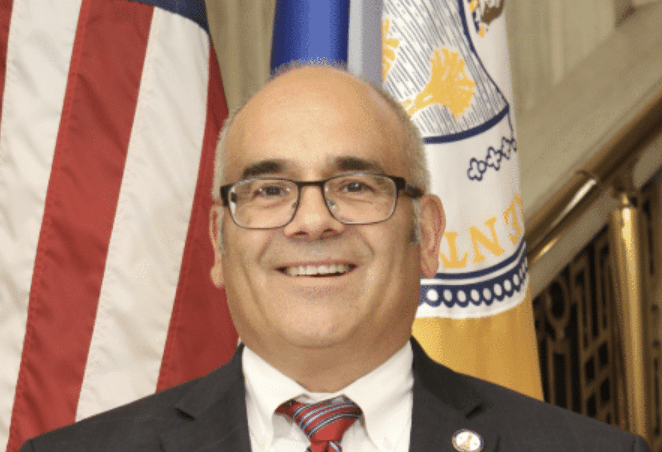
This op-ed is written by Douglas H. Palmer, former Mayor of Trenton.