Trenton Makes connects youth activism to local issues
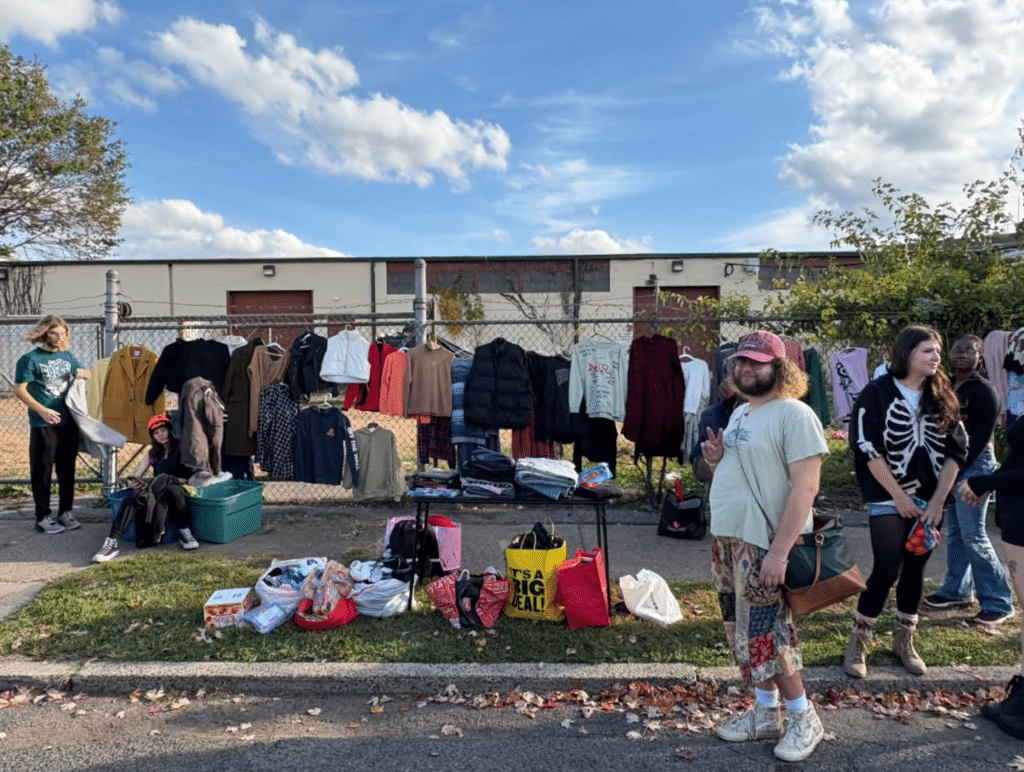
Recently at Mill Hill Park, a group of young people gathered as part of Trenton Makes, a youth-led grassroots organization focused on building community power and connecting young people to fight against issues such as historical redlining, gentrification, and homelessness.
Composed primarily of college-aged young adults, the group meets weekly, holding tablings and discussions with state workers, the homeless, and working-class people about the experiences and insights in the community.
During the meetup, members were looking to interview state workers about their experiences and concerns regarding Trenton, its governance, and what they believe should change in the city. Ultimately, Trenton Makes hopes to compile what they learn and schedule a meeting with the mayor to discuss their findings.
Amara (group members requested we not disclose their last names) of Trenton Makes told the Trenton Journal how the organization came together.
“A lot of us found each other during the Pro-Palestine movement in 2023,” she said.
She explained that the group began recognizing connections between international issues and challenges facing communities closer to home.
“What we saw is that a lot of the issues that people really cared about, like displacement, disenfranchisement, lack of political representation—all of those things weren’t just happening in Palestine at the hands of Israel; they’re happening in our state, in cities that we live in right now,” Amara said.
Trenton Makes has attempted to draw connections between international politics and local issues. On its Instagram page, the organization has questioned why taxpayer dollars are directed toward military spending rather than addressing issues such as homelessness.
According to the Institute for Policy Studies, a progressive think tank, the average U.S. taxpayer in 2025 contributed approximately $4,330 toward military spending, compared with about $542 toward housing and community development.
Why Trenton?
Amara isn’t from Trenton, and neither was anyone else from the group who gathered at Mill Hill Park that day. That raises a question: Why are young people from outside the city so focused on Trenton?
Rem, who manages Trenton Makes’ social media and grew up in Princeton, said the organization has approximately 30 members, most of whom are actually from Trenton.
For Rem, her involvement is partly rooted in challenging perceptions of the city.
“In a town like [Princeton], the bubble would say don’t go outside of Princeton,” she said.
She recalled being told that Trenton and New Brunswick were unsafe at night. But after spending time in Trenton herself, she said her experience didn’t match those warnings.
Instead, Rem described Trenton as a welcoming city and said she felt more comfortable there than she had expected.
Amara offered another explanation for the group’s interest in Trenton, tying it directly to the organization’s broader mission.
“The goal is building power for the people at the very bottom. And as people who do have just a bit more sway, we want to back the people at the bottom,” she said.
Trenton also holds a unique position in New Jersey as the state capital. Major state government institutions, including the State House, are located in the city, making Trenton a frequent gathering place for demonstrations and political protests, including recent protests related to the war in Iran.
Taking Their Questions to the State House
During their meetup, Trenton Makes members approached state workers during their lunch breaks to ask about their experiences and perspectives on issues affecting the city.
The conversations were sometimes abrupt, but workers representing a range of ages and positions—from security guards to interns—were willing to speak with the group.
One young man discussed New York City Mayor Zohran Mamdani and his belief that Mamdani has sought to fill his administration with diverse voices that reflect the people he represents. He said Trenton residents should similarly feel represented by their local government.
Many of the conversations touched on issues that aligned with concerns Trenton Makes had already identified. But not everyone agreed with the group’s perspectives.
A man who has worked in Trenton since the 1980s and is employed by the New Jersey Department of Environmental Protection offered a different view on homelessness.
“The more help the city gives the homeless, the worse everything gets,” he said.
He did not believe the city was solely responsible for Trenton’s homelessness challenges. Having grown up in New York, he said he viewed homelessness as an issue common to large urban areas.
He did, however, express concerns about lead contamination and abandoned buildings. He identified Trenton Water Works as the city’s most important environmental issue.
Building Community Outside the Ballot Box
Political organizing isn’t the only way Trenton Makes has sought to build community.
Last year, members organized barbecues and clothing distributions. The group says it wants to build power within the community outside traditional electoral politics and established institutions.
For its members, that means engaging directly with residents, workers and young people and creating opportunities for people to discuss the issues affecting their communities.
As young people’s confidence in traditional political institutions continues to shift, groups like Trenton Makes represent one form of youth civic engagement that exists outside conventional political structures.
The organization is still young, but its members say they intend to keep asking questions, talking with residents and government workers, and looking for ways to turn those conversations into action in Trenton.